What Questions Should Clients Ask Before Booking Braiding Services?
Key Takeaways:
|
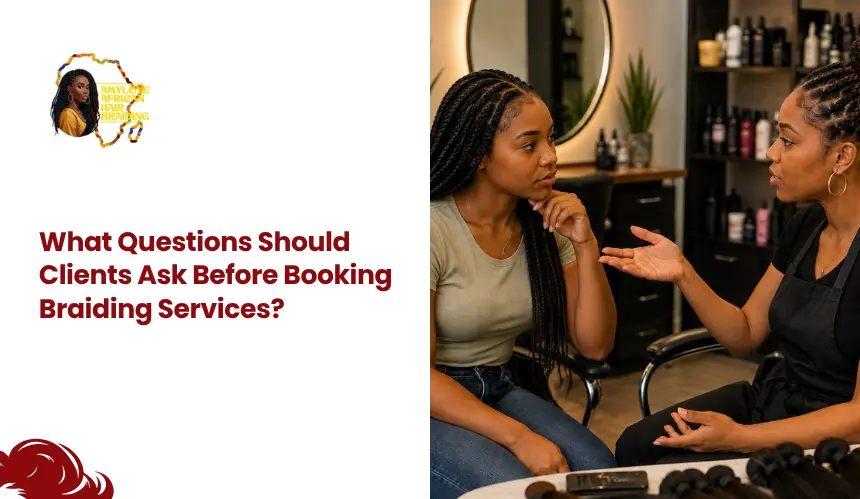
Choosing a braiding service without asking the right questions often leads to mismatched expectations, excessive tension, or results that do not last. Proper questioning acts as a screening process that filters out unsuitable providers and aligns the service with your specific hair needs.
This guide breaks down the key questions clients should ask to make informed, low-risk decisions before booking braiding services.
Why Asking the Right Questions Before Booking Matters
Most issues with braiding services originate before the appointment begins, not during execution. When clients skip key questions, the braider works with incomplete information about hair condition, desired tension, or styling expectations. This gap leads to outcomes that may look acceptable initially but fail in durability, comfort, or scalp health within days.
Braiding is a technique-sensitive service where small variations in parting, tension, and product use directly affect long-term results. For example, excessive tension during installation can create immediate neatness but increases the risk of traction-related hair loss over time. Without prior discussion, this trade-off is often not addressed.
Clear questioning also defines operational boundaries such as service inclusions, appointment duration, and preparation requirements. When these variables remain undefined, clients face delays, additional charges, or incomplete services. A structured pre-booking conversation eliminates these uncertainties and aligns both sides on execution standards.
From a decision standpoint, asking targeted questions functions as a filtering mechanism. It helps identify whether the braider’s process, experience, and service model match the client’s hair type, lifestyle, and maintenance capacity. This reduces the probability of corrective rework, early removal, or additional styling costs.
What Should You Ask About the Braider’s Experience and Specialization?
Selecting a braider without verifying their specialization often results in inconsistent execution, especially for complex or technique-specific styles. Braiding is not a one-size skill set. Precision in parting, tension control, and finishing varies significantly depending on the style and hair characteristics.
Do They Specialize in Your desired Braid Style?
Different braid types require distinct installation methods and pattern control. A braider experienced in knotless braids may not deliver the same precision in feed-in cornrows or micro braids. Asking about specialization ensures the stylist routinely performs the exact style you want, reducing the risk of uneven sections, bulky roots, or premature loosening.
Can They Show Recent Work or Client Results?
A current portfolio reflects consistency, not just capability. Reviewing recent client results helps evaluate parting symmetry, braid uniformity, scalp visibility, and finishing quality. It also reveals whether the braider maintains the same standard across different clients rather than showcasing only select outcomes.
How Do They Handle Different Hair Types and Textures?
Hair density, curl pattern, and scalp sensitivity directly influence braiding technique. A skilled braider adjusts section size, tension, and product use based on these variables. Asking this question clarifies whether they can manage thick, fine, or highly coiled hair without causing breakage, discomfort, or uneven braid distribution.
What Questions Clarify Pricing, Time, And Service Scope Before Booking Braiding?
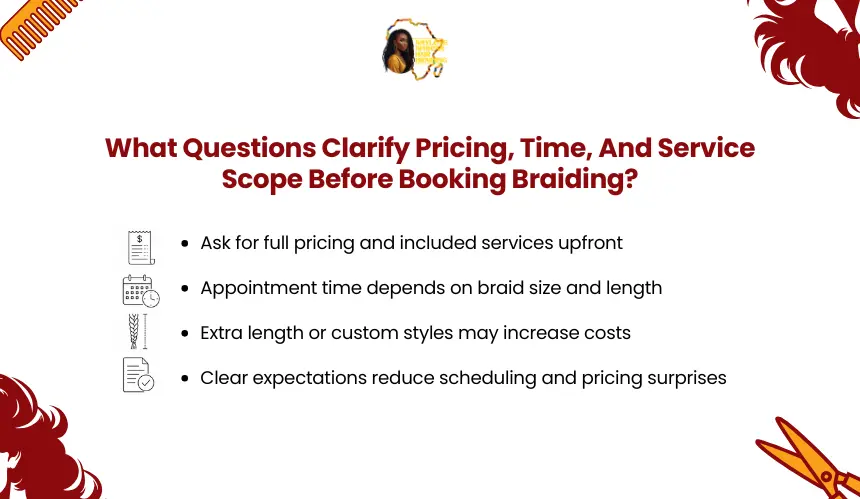
Service pricing in braiding is variable and depends on multiple operational factors. Without clear upfront questions, clients often face extended appointment times or additional charges that were not initially disclosed. Defining scope before booking ensures alignment on both cost and time commitment.
1. What Is The Total Cost And What Does It Include?
Pricing structures differ based on whether the service includes hair extensions, washing, blow-drying, or finishing products. Some braiders quote a base rate and add charges for length, thickness, or styling variations. Asking for a full cost breakdown prevents underestimation and ensures there are no hidden add-ons at the end of the service.
2. How Long Will The Appointment Realistically Take?
Time estimates depend on braid size, length, and hair density. Standard styles like medium box braids typically take 4 to 6 hours, while smaller or longer styles such as knotless or waist-length braids can range from 6 to 10+ hours.
Micro braids or highly detailed work may extend beyond a full day. A realistic timeframe helps clients plan around fatigue, scheduling conflicts, and overall comfort during long sessions.
3. Are There Additional Fees For Specific Requests?
Customizations such as extra length, intricate parting patterns, or color blending often increase both time and cost. Some providers also charge for last-minute bookings or high-demand time slots. Clarifying these variables in advance avoids unexpected pricing adjustments and ensures the final result matches the agreed scope.
What Questions Should You Ask About Hair Preparation And Aftercare Before Booking?
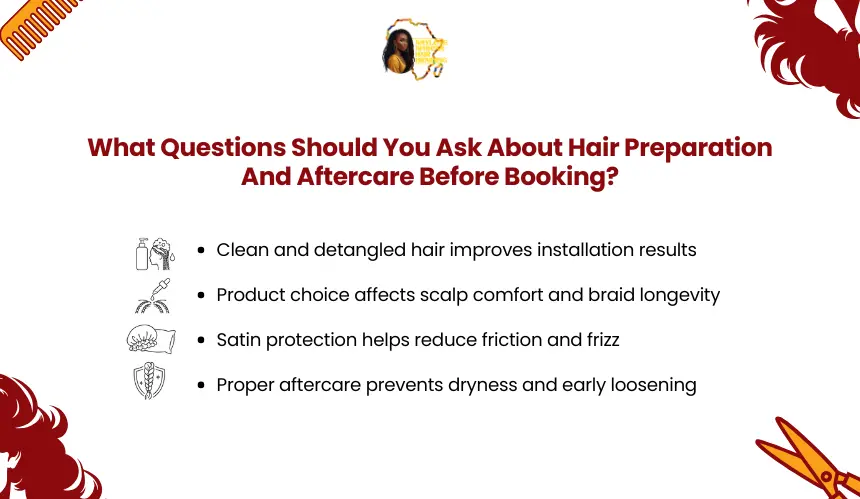
Hair condition before installation and maintenance after braiding directly determine how long the style lasts and how well the scalp tolerates it. Without clear guidance, improper prep or poor aftercare can lead to buildup, tension stress, or early frizzing.
1. How Should You Prepare Your Hair Before The Appointment?
Preparation requirements vary by braider, but most expect clean, fully detangled, and stretched hair. Some require blow-drying to create uniform sections and reduce installation time. Skipping these steps can delay the process or result in uneven tension distribution during braiding.
2. What Products Or Techniques Do They Use During Braiding?
Product choice affects scalp health and braid durability. Heavy gels or excessive product layering can cause buildup, while improper tension techniques increase strain on hair follicles. Asking this clarifies whether the braider prioritizes controlled tension, clean parting, and minimal product use for long-term comfort.
3. What Aftercare Steps Are Recommended?
Aftercare determines how well the style holds over time. Key practices include scalp hydration, light oil application, and protecting braids during sleep using satin or silk coverings. Without a defined aftercare routine, clients often experience dryness, itchiness, or early loosening of braids.
What Questions Should You Ask About Hygiene, Safety, And Comfort Before Braiding?
Braiding involves prolonged contact with the scalp and repeated tool use, which introduces hygiene and safety considerations that are often overlooked. Without verifying these factors, clients risk scalp irritation, infections, or unnecessary physical strain during long sessions.
1. Are Tools And Workstations Properly Sanitized?
Reusable tools such as combs, clips, and parting instruments must be cleaned between clients to prevent bacterial or fungal transfer. A professional setup includes disinfected tools, clean work surfaces, and proper handling of hair extensions. This question helps confirm whether basic hygiene protocols are consistently followed.
2. How Do They Manage Tension And Scalp Sensitivity?
Excessive tension during installation can cause immediate discomfort and long-term follicle damage. A skilled braider adjusts grip strength, section size, and anchoring technique based on scalp sensitivity. Asking this ensures the braider prioritizes controlled tension rather than overly tight results that compromise hair health.
3. What Is The Environment Like During The Appointment?
Braiding sessions often last several hours, making physical comfort a critical factor. Seating quality, break allowances, and workspace setup affect overall endurance during the service. Understanding whether the appointment takes place in a home studio or professional salon also sets expectations for noise levels, privacy, and overall experience quality.
How Do Local Conditions In Washington Areas Affect Hygiene And Comfort?
Environmental and operational conditions can vary across regions like University Place, Lakewood, and Puyallup. Home-based setups in residential neighborhoods may differ from commercial salon standards in terms of ventilation, space, and sanitation consistency.
Climate factors such as humidity and temperature can also influence scalp sensitivity and product behavior during braiding. Asking about the setup in your specific area helps determine whether the environment supports safe, comfortable, and hygienic service delivery.
The right questions lead to the right results, and the right braider makes all the difference. At AmyLove African Hair Braiding, every service begins with clear consultation, precise technique, and a focus on long-lasting, comfortable styles. If you’re ready to book with confidence and avoid costly mistakes, connect with a team that prioritizes both style accuracy and hair health from the start.
Frequently Asked Quetions
How do I know if a braid style is too heavy for my hairline?
Weight risk usually shows up when the style combines small sections, added length, and dense extension hair near the front edges. Clients with fine strands, postpartum shedding, or existing thinning should ask for lighter braid density, larger sections, or shorter lengths to reduce continuous traction on vulnerable areas.
Should I bring my own braiding hair, or let the braider provide it?
The safer choice depends on quality control and allergy history. Bringing your own hair gives you control over brand, texture, length, and fiber type, especially if you react to coated synthetic hair. If the braider provides it, ask exactly what brand is used and whether pre-rinsing is recommended.
What are the biggest red flags before paying a deposit?
Warning signs usually appear in communication, not just styling photos. Vague pricing, no clear arrival instructions, refusal to discuss hair suitability, inconsistent portfolio quality, and pressure to book without consultation often signal poor service structure. A professional braider should communicate process, expectations, and limits with clarity before payment.
What should I do if my braids feel too tight after the appointment?
Pain that causes bumps, headaches, scalp redness, or difficulty sleeping points to excessive tension rather than normal adjustment. Clients should contact the braider within 24 to 48 hours and request loosening around the perimeter or high-tension rows. Waiting too long increases the risk of breakage, inflammation, and traction damage.
How long should I keep braids in before they start causing problems?
Most braided protective styles are best removed within about 6 to 8 weeks, depending on hair growth, scalp buildup, and section size. Keeping them longer can increase matting at the roots, weaken shed-hair release, and make takedown more damaging. Smaller braids usually require closer monitoring than larger styles.
Can I still book braiding services if my hair is short, fine, or uneven?
Hair length alone does not decide braid suitability. The better question is whether the hair can anchor extensions without excess tension or visible stress at the root. Fine or uneven hair may need larger parts, lower-density add-in hair, or styles that avoid heavy perimeter load and sharp pulling.