What Products Should Be Avoided With Braided Hairstyles?
Key Takeaways:
|
Braided hairstyles protect hair structure, but the wrong product choices often trigger buildup, scalp irritation, and premature breakage beneath the style. Many commonly used oils, creams, and sprays are not formulated for braided conditions, where limited access to cleansing and increased scalp tension change how products behave.
Misapplication or incompatible formulations can quietly weaken hair over time without visible warning signs. This article identifies which products to avoid and explains how they impact scalp health, braid longevity, and overall hair integrity.
Why Does Product Selection Matter For Braided Hairstyles?
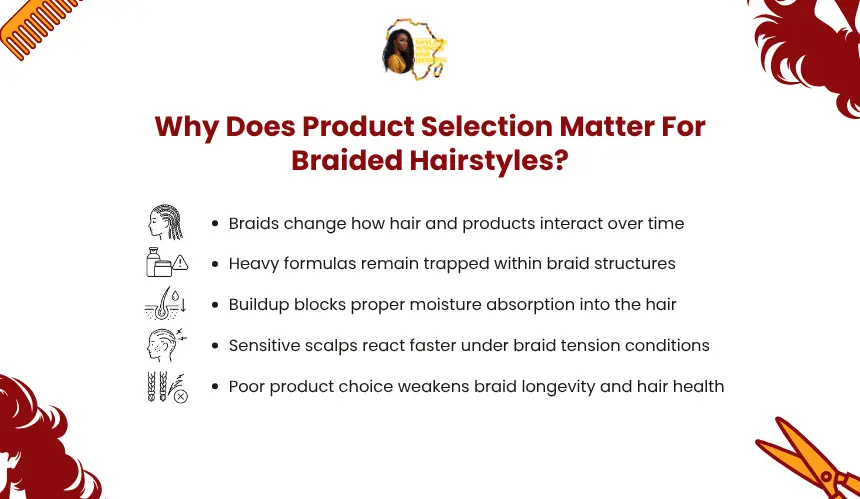
Braided styles change how the scalp and hair interact with products, making formulation choice a direct factor in long-term hair condition and braid performance. Unlike loose hair, braids restrict natural oil distribution and reduce the frequency of washing, which alters how residues accumulate and how the scalp responds to external products.
Product behavior under braids is influenced by three key mechanisms: limited product removal, increased scalp exposure, and sustained tension at the roots. When heavy or incompatible formulations are applied, they remain trapped along the braid shaft and scalp surface, leading to buildup that cannot be easily rinsed out. This buildup creates a barrier that interferes with moisture absorption and disrupts the scalp’s natural balance.
In parallel, the scalp remains more exposed between parts, making it more sensitive to chemical irritants, alcohol-based ingredients, or artificial fragrances. Under constant tension from braiding, even minor irritation can escalate into inflammation, itching, or follicle stress. Over time, this increases the risk of traction-related hair loss and weakened root stability.
The cumulative effect of poor product selection is reduced braid longevity, visible dullness, and compromised hair integrity beneath the style. Product compatibility is not a cosmetic preference in braided care. It directly determines how well the style holds, how healthy the scalp remains, and how much breakage occurs after removal.
Heavy And Buildup-Causing Products That Damage Braids
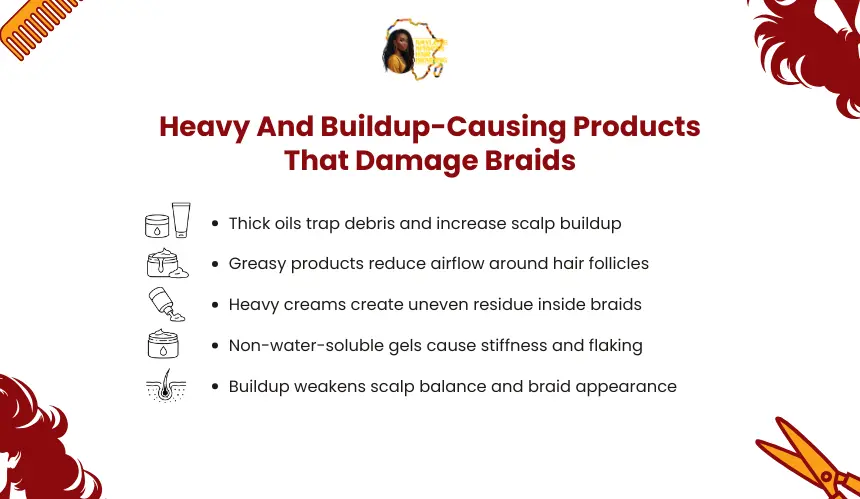
Braided hairstyles limit regular cleansing, so any product that is not easily absorbed or rinsed out tends to accumulate over time. These accumulations interfere with scalp function, attract environmental debris, and reduce the overall lifespan of the style. The issue is not just heaviness, but how long the product remains trapped within the braid structure.
1. Thick Oils And Greasy Pomades
Dense oils and petroleum-based pomades sit on the surface rather than penetrating effectively, especially when applied repeatedly. Their viscosity causes them to bind with dust, sweat, and dead skin cells, forming a persistent layer along the scalp and braid roots.
This layer restricts airflow to follicles and increases the likelihood of clogged pores, which can lead to irritation and reduced hair growth efficiency.
2. Heavy Creams And Butters
Products formulated with high concentrations of butters or thick emollients are designed for loose hair absorption, not confined braided structures. When used on braids, they settle into the base and along the strands without proper distribution, creating uneven residue.
Over time, this results in dull-looking braids, increased weight on the roots, and difficulty in fully cleansing the scalp during wash cycles.
3. Non-Water-Soluble Gels And Waxes
Gels and waxes that are not water-soluble form rigid coatings that resist breakdown during washing. In braided styles, this leads to flaking, visible residue buildup, and stiffness that disrupts the natural flexibility of the braids.
The accumulation also prevents moisture from reaching the hair shaft, contributing to dryness and increased brittleness underneath the surface.
Products That Disrupt Scalp Balance In Braids And Cause Irritation
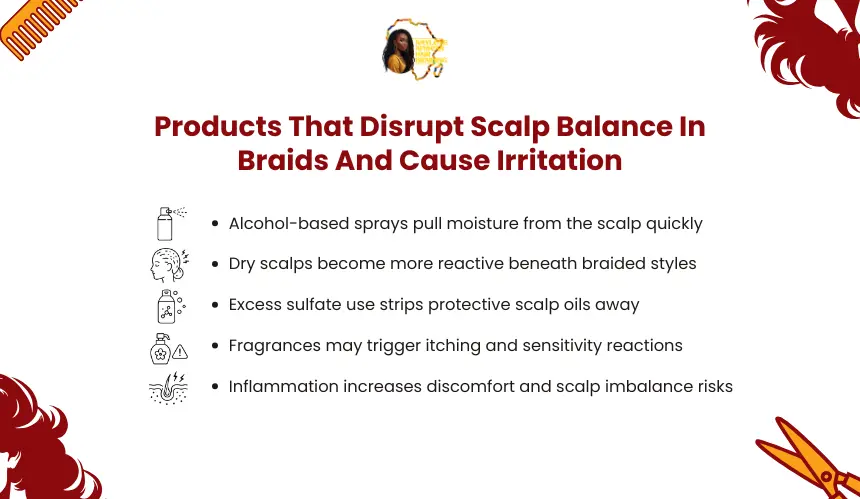
Braided styles expose the scalp between parts while maintaining constant tension at the roots. Under these conditions, ingredient sensitivity increases, and formulations that alter the scalp’s natural balance can trigger irritation more quickly than they would on loose hair. The issue is not residue buildup, but how certain ingredients chemically interact with the scalp environment.
1. Alcohol-Based Sprays And Styling Products
Short-chain alcohols such as ethanol and isopropyl alcohol evaporate rapidly, pulling moisture from the scalp surface in the process. In braided conditions, where hydration recovery is slower, this leads to persistent dryness, tightness, and itching. Repeated exposure weakens the scalp barrier, increasing sensitivity and making the skin more reactive to other products.
2. Sulfate-Heavy Shampoos When Overused
3. Fragranced And Chemical-Heavy Formulations
Artificial fragrances and certain preservatives introduce compounds that can trigger contact irritation, especially on a scalp under tension. Braided parts create direct pathways for these ingredients to reach the skin, increasing the likelihood of inflammation or itching. In sensitive individuals, this can escalate into redness, discomfort, or disruption of the scalp’s microbial balance, affecting overall hair health.
Important: fragrance-free and unscented do not mean the same thing. Dermatologists note that unscented products can still contain masking fragrance ingredients, which means a product that smells neutral can still trigger scalp irritation under braids. |
Moisture-Misleading Products In Braids That Lead To Hidden Damage
Some products are marketed as hydrating or nourishing but fail to deliver functional moisture under braided conditions. Instead of improving hair health, they create surface-level effects that mask underlying dryness. In braids, where direct hydration is already limited, these misleading formulations can accelerate structural damage without immediate visible signs.
1. Silicone-Heavy Conditioners And Sprays
Silicones form a coating around the hair shaft that creates a smooth, glossy appearance. In braided styles, this coating becomes a barrier that blocks water-based moisture from penetrating the hair.
Since braids reduce regular washing, the silicone layer accumulates over time, leaving the hair underneath progressively drier and more prone to brittleness despite appearing conditioned on the surface.
2. Protein-Overload Treatments
Protein treatments strengthen hair when used in balance, but excessive application disrupts elasticity. In braids, where hair is already under constant tension, reduced flexibility increases the likelihood of breakage at stress points, particularly near the roots and along the braid pattern. This type of damage often becomes noticeable only after the braids are removed.
3. Shine Sprays With Synthetic Coatings
Shine-enhancing products rely on light-reflective agents that sit on the outer layer of the hair. In braided styles, these coatings do not dissipate easily and combine with environmental particles to form residue. While they temporarily improve visual appearance, they contribute to long-term dullness, stiffness, and reduced moisture absorption within the braid structure.
Common Product Mistakes People Make With Braids
Beyond ingredient selection, application habits determine how products behave within braided structures. Even suitable formulations can create problems when used incorrectly, as braids change how products distribute, absorb, and remain on the scalp over time.
Over-Applying Products To The Scalp In Braids
Applying excessive product directly to the scalp leads to saturation without proper dispersion. Since braids limit movement and absorption pathways, the excess settles at the roots and within part lines. This creates a dense layer that traps sweat and debris, increasing the risk of itching, follicle blockage, and uneven scalp conditions.
Using Products Designed For Loose Hair On Braids
Many styling and conditioning products are formulated for loose hair where distribution through combing or brushing is possible. In braided styles, these products cannot spread evenly, resulting in concentrated deposits at specific points. This mismatch leads to inconsistent hydration, localized buildup, and reduced effectiveness of the product’s intended function.
Layering Multiple Incompatible Products In Braids
Combining oils, creams, sprays, and gels without considering formulation compatibility creates compound residue. Each layer interacts differently with the braid surface, often leading to separation, flaking, or sticky buildup. Over time, this layered accumulation becomes difficult to remove and interferes with both scalp health and the structural integrity of the braids.
What To Use Instead For Safe Braids Maintenance
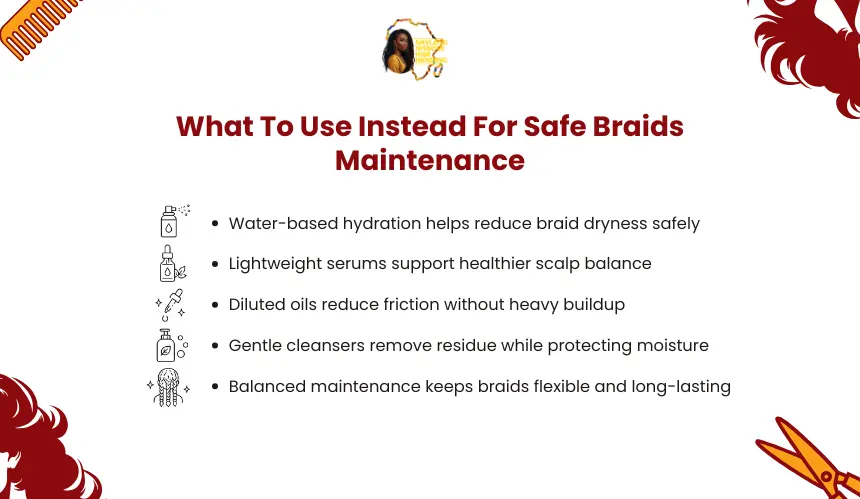
Avoiding harmful products is only effective when replaced with formulations that align with how braids retain moisture and interact with the scalp. The goal is to maintain hydration, support scalp balance, and prevent residue accumulation without disrupting the structure of the style.
Lightweight, Water-Based Moisturizers For Braids
Water-based formulations deliver hydration that can penetrate between braid patterns without leaving surface residue. These products absorb more efficiently under low-manipulation conditions, helping maintain moisture levels at both the scalp and along the braid length. Consistent use prevents dryness without contributing to buildup.
Diluted Oils And Scalp-Friendly Serums For Braids
Oils applied in diluted or lightweight forms provide lubrication without overwhelming the scalp. When used sparingly, they help reduce friction at the roots and maintain flexibility within the braid structure. Scalp-specific serums with balanced formulations support hydration while minimizing the risk of clogged follicles or residue formation.
Clarifying And Gentle Cleansing Solutions For Braids
Periodic cleansing with mild, low-residue shampoos or diluted cleansing solutions helps remove accumulated particles without stripping essential moisture. These formulations break down buildup effectively while preserving the scalp’s natural balance. Proper cleansing ensures that hydration products remain effective and prevents long-term accumulation within the braids.
A 2024 dermatology guideline noted that people with tightly coiled hair and scalp conditions such as seborrheic dermatitis are often advised to shampoo once a week, which reinforces the idea that buildup under braids usually needs controlled cleansing, not more product layered on top. |
How Should Braids Care Adapt In The South Puget Sound Area?
In the South Puget Sound area, including Lakewood, Puyallup, University Place, and Parkland, cooler temperatures and seasonal dryness shift product performance toward moisture retention challenges. Under these conditions, hydration must come from lightweight, water-based sources rather than heavy oils that sit on the surface.
Low-humidity periods increase transepidermal water loss from the scalp, which makes frequent use of alcohol-based sprays or harsh cleansers more damaging. Instead, controlled application of water-based moisturizers combined with minimal, diluted oil sealing helps maintain balance without creating buildup.
Aligning product choice with regional climate ensures braids remain hydrated, flexible, and structurally stable over extended wear.
Healthy braids start with the right techniques and the right product choices. If you want styles that last longer, feel lighter, and protect your natural hair, expert care makes the difference. AmyLove African Hair Braiding focuses on braid health, scalp balance, and long-term hair integrity so your style looks good and performs better from day one.
Frequently Asked Quetions
Can dry shampoo make braids look cleaner while actually making buildup worse?
Why do my braids still itch when I’m only using natural oils?
Natural oils are not automatically scalp-safe under braids. Persistent itching may come from contact dermatitis, fragrance sensitivity, occlusion, or dandruff rather than a lack of oil. Fragrances and preservatives are common allergens, and longer gaps between washes allow more sebum and residue to sit on the scalp.
Can braiding hair cause itching even if I’m using the right products?
That is a real possibility, especially with synthetic extensions. Recent testing reported carcinogens, lead, and VOCs in popular synthetic braiding hair products, and online braid communities often connect burning or itching to factory coatings on the hair rather than to a moisturizer or braid spray alone.
Should I moisturize my scalp or the braid length when my hair feels dry?
Treat scalp dryness and braid-length dryness as separate issues. When the hair itself feels rough, a light water-based mist on the braid length is usually more useful than adding more oil to the parts. Minimal scalp product works better when the concern is tightness, flaking, or friction at the roots.
When does product buildup stop being cosmetic and start looking like a scalp condition?
Buildup starts behaving like a scalp condition when it becomes persistent, greasy, odorous, inflamed, or resistant to a normal wash. The AAD notes that dandruff, dry scalp, and other disorders can resemble each other, so ongoing itching or visible scaling after over-the-counter care is a reason to get evaluated.
At what point should braids come down instead of trying another product?
Product switching stops being the answer once braids cause pain, stinging, bumps, pustules, or lasting tenderness, especially around the hairline. Dermatology sources identify those as early tension-related warning signs, and the AAD advises removing styles that hurt or irritate the scalp instead of masking symptoms with more products.