How Do Knotless Braids Reduce Scalp Tension?
Key Takeaways
|
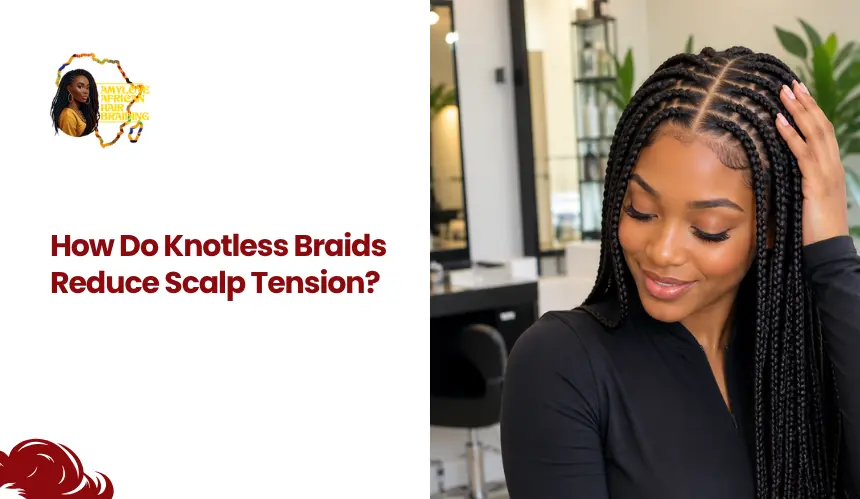
Tight braids often come with an uncomfortable trade-off. That pulling sensation at the roots, the soreness after installation, and even long-term hair thinning are all signs of excessive scalp tension. Many people experience this with traditional styles like box braids, where the base knot creates immediate pressure on the hair follicles.
Knotless braids offer a different experience. By using a feed-in technique that avoids tight anchoring at the root, they reduce stress on the scalp while still delivering a protective hairstyle. Understanding how this structural difference works helps explain why this method is widely considered more comfortable and scalp-friendly.
What Causes Scalp Tension In Traditional Braids?
Before understanding why knotless braids feel more comfortable, it helps to break down what actually creates tension in traditional braiding styles. The discomfort is not random. It is directly tied to how the braid is anchored, how weight is distributed, and how force is applied to the scalp during installation.
Knot At The Base Creates Immediate Tension
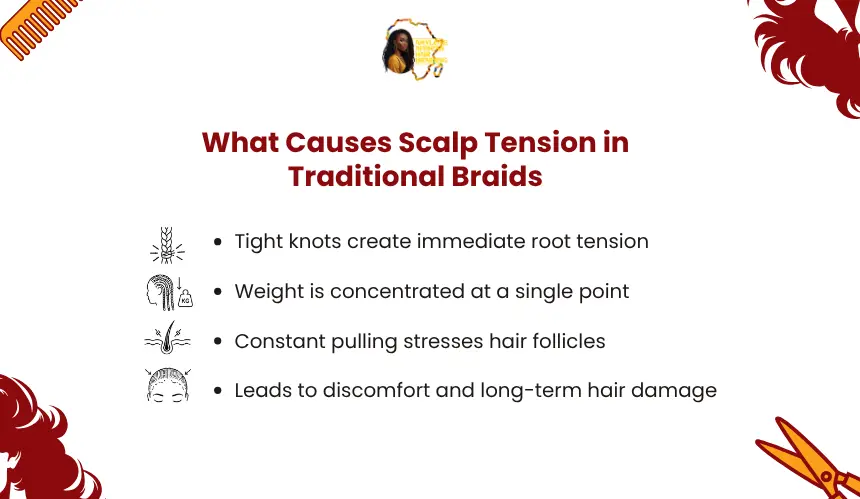
Traditional braids begin with a tight knot at the root, which acts as the anchor point for added extensions. This knot locks the hair in place instantly, creating a concentrated pulling force on a small section of the scalp.
Because the hair is gripped tightly at one point, the pressure does not spread evenly. Instead, it pulls directly on the hair follicles, leading to soreness, especially around sensitive areas like the hairline and nape. This is one of the primary reasons people feel pain right after getting box braids.
Uneven Weight Distribution Affects the Scalp
In knot-based braiding, most of the extension weight is attached at the base from the start. This creates a heavy load on a single point rather than distributing it along the length of the braid.
As a result, the scalp experiences constant downward tension. Over time, this uneven weight distribution can strain the roots, making the style feel tighter and less flexible during movement. This is especially noticeable when multiple braids pull in the same direction.
What Are The Long-Term Effects Of Constant Scalp Pulling?
Continuous tension on the scalp can lead to more than just temporary discomfort. Repeated stress on hair follicles is a known cause of traction alopecia, a condition where hair gradually weakens and falls out due to prolonged pulling.
In addition, the scalp may become inflamed or sensitive, making it harder to maintain protective hairstyles over time. Recognizing these underlying causes makes it easier to see why reducing tension at the root is essential for both comfort and long-term hair health.
Important: Research published in Clinical, Cosmetic and Investigational Dermatology shows that traction alopecia affects about one-third of women of African descent who regularly wear prolonged tension-based hairstyles. |
How Knotless Braids Work Differently At The Root Level
Once the cause of scalp tension is clear, the distinction in knotless braiding comes down to how the braid is constructed from the very first step. The technique changes the way force is introduced to the scalp, focusing on gradual integration instead of immediate anchoring.
Feed-In Technique Builds The Braid Structure Gradually
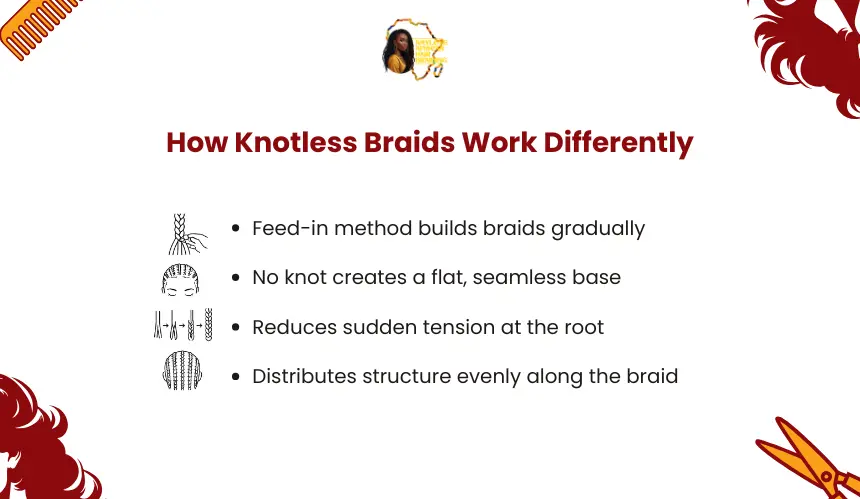
Knotless braids begin with natural hair, and extensions are added in small, controlled increments as the braid progresses. This creates a layered structure where the braid develops step by step instead of forming all at once.
This gradual build allows the braid to take shape without forcing the scalp to support added hair instantly. The structure forms progressively, aligning more closely with the natural growth pattern of the hair.
Absence Of A Knot Changes The Base Formation
Unlike traditional braids, there is no tied base securing the extensions at the root. The braid emerges smoothly from the scalp, creating a seamless transition between natural hair and added hair.
This method eliminates the need for a fixed anchor point, allowing the braid to form without compressing the root area into a tight hold. The base remains flat and integrated rather than raised or bulky.
How Does Knotless Technique Affect The Overall Braid Formation Pattern?
In knot-based braiding, most of the extension weight is attached at the base from the start. This creates a heavy load on a single point rather than distributing it along the length of the braid.
This formation method supports a more balanced braid architecture, where the structure develops evenly rather than being defined by a single starting point.
Key Ways Knotless Braids Reduce Scalp Tension
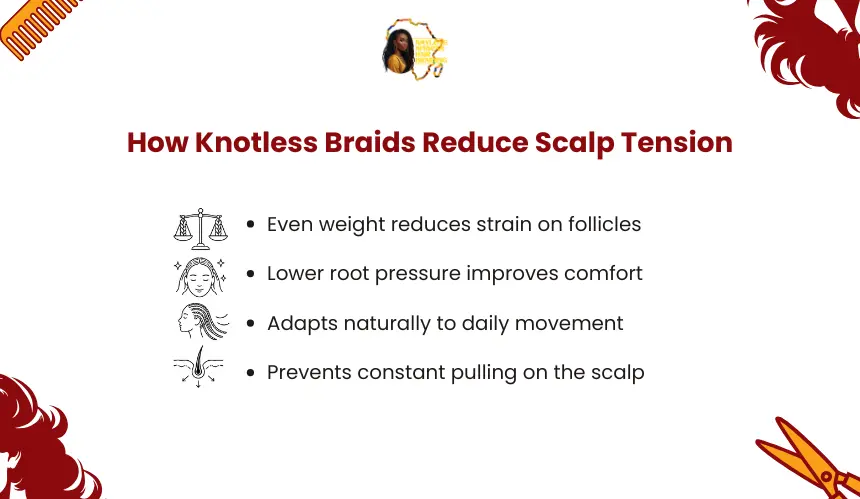
With the structural foundation in place, the impact of knotless braids becomes evident in how the scalp responds over time. The benefits are tied to how force is distributed, how the scalp adapts, and how the style behaves during daily wear.
Even Distribution Of Hair Reduces Follicle Strain
Since extensions are incorporated progressively, the load is shared across the entire braid rather than concentrated at one نقطة. This balanced distribution prevents excessive stress from building up in a single area.
Each section of hair carries a proportionate amount of weight, which reduces strain on individual follicles. This helps maintain a more stable and less stressful environment for the scalp.
Reduced Root Pressure Supports Scalp Stability
Without a tightly secured base, the root area is not subjected to continuous downward force. This allows the scalp to remain in a more neutral state instead of being pulled in one direction.
Lower pressure at the root supports better circulation around the follicles and reduces the likelihood of stress-related sensitivity over time.
How Do Knotless Braids Adapt To Natural Head Movement?
Knotless braids respond more fluidly to everyday motion, whether it is turning the head, tying the hair, or resting during sleep. This adaptability prevents repeated tension buildup caused by rigid styling.
The scalp is not forced to resist constant directional pulling, which helps maintain comfort throughout the duration of the hairstyle.
Who Benefits Most From Knotless Braids
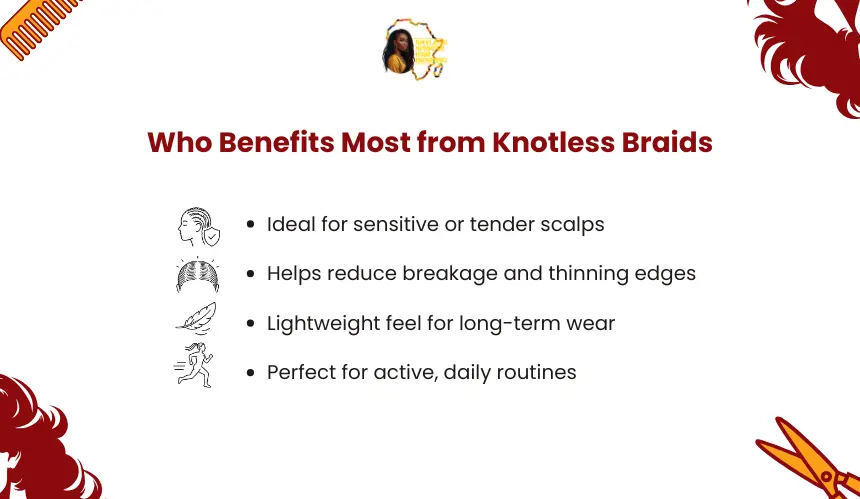
Not every protective hairstyle delivers the same results for every individual. The effectiveness of knotless braids becomes more evident when aligned with specific scalp conditions, hair concerns, and lifestyle needs. This section highlights who gains the most from reduced tension and improved braid dynamics.
1. Individuals With Sensitive Scalps
People with tender or reactive scalps often experience discomfort with tight braiding techniques. Knotless braids offer a more manageable approach because the scalp is not exposed to sudden pulling during installation.
This allows the skin around the follicles to remain calmer, reducing the likelihood of irritation, soreness, or post-installation discomfort that is commonly associated with tighter styles.
2. People Experiencing Hair Thinning Or Breakage
Hair that is already fragile requires styles that do not add additional stress to the roots. Knotless braids help maintain a more stable environment by avoiding excessive strain on delicate areas like the edges and temples.
This makes them a suitable option for individuals looking to preserve hair density and minimize further weakening caused by constant tension.
3. Those Seeking Lightweight Protective Styles
Many people prefer protective hairstyles that do not feel heavy or restrictive. Knotless braids provide a more balanced feel because the braid structure does not create bulk at the base.
This results in a style that is easier to wear for extended periods while still protecting natural hair from daily manipulation and environmental exposure.
How Local Lifestyle And Environment Influence Protective Styling Choices
In areas like Lakewood, Parkland, Puyallup, and University Place, lifestyle patterns and environmental conditions can influence scalp sensitivity and hair care choices. Frequent weather shifts, outdoor exposure, and active routines often make low-tension protective styles more practical.
Knotless braids are especially beneficial for individuals in these communities who want a style that remains comfortable during daily movement, commuting, and changing weather conditions. The reduced strain on the scalp makes it easier to maintain both comfort and hair health over longer wear periods.
Best Practices To Maximize Tension Reduction
Even though knotless braids are designed to reduce scalp stress, the final result still depends on how the style is installed and maintained. Small decisions during preparation and aftercare can significantly influence how much tension the scalp experiences over time.
1. Choosing The Right Braiding Technique
The technique used during installation plays a direct role in how tension is managed. A skilled stylist focuses on controlled hand pressure, consistent section sizing, and gradual extension integration.
When the technique is executed correctly, the braid forms without unnecessary pulling. This ensures the scalp is not exposed to hidden stress points that can build discomfort after a few days.
2. Proper Sectioning And Hair Preparation
Clean sectioning ensures that each braid is evenly distributed across the scalp. When sections are too small or uneven, certain areas may carry more load than others, leading to localized tension.
Preparing the hair with proper hydration and detangling also improves flexibility at the root. This allows the hair to adapt more easily during braiding without resisting or tightening under pressure.
3. Avoiding Overly Tight Styling After Braiding
4. Maintaining Scalp Health During Wear
Knotless braids are often associated with comfort and scalp-friendly styling, but several misconceptions can lead to unrealistic expectations. Understanding what this technique actually offers helps in making informed decisions without overestimating its benefits.
Common Misconceptions About Knotless Braids
Knotless braids are often associated with comfort and scalp-friendly styling, but several misconceptions can lead to unrealistic expectations. Understanding what this technique actually offers helps in making informed decisions without overestimating its benefits.
Myth 1: They Have No Tension At All
A common belief is that knotless braids completely eliminate tension. In reality, any braided style involves some level of force to secure the hair. The difference is that knotless braids reduce and control that tension rather than removing it entirely.
The experience feels more comfortable because the stress is not concentrated at one point. However, improper technique or tight handling can still introduce unnecessary strain.
Myth 2: They Do Not Last As Long As Traditional Braids
Some assume that the absence of a knot makes the style less durable. Longevity, however, depends more on installation quality, sectioning precision, and maintenance habits than on the presence of a knot.
When done correctly, knotless braids can maintain their structure and neatness for a comparable duration, especially with proper scalp care and minimal excessive manipulation.
Myth 3: They Are Only Suitable For Certain Hair Types
Another misconception is that knotless braids only work well for specific textures or hair densities. In practice, the technique can be adapted to suit a wide range of hair types with adjustments in section size and extension blending.
What matters more is the method used during installation rather than the hair type itself, making knotless braids a flexible option for many individuals seeking a low-tension protective style.
For a smooth, low-tension experience done right, you can trust the expertise of AmyLove African Hair Braiding and enjoy braids that work with your hair, not against it. Give your scalp the break it needs while keeping your style effortlessly on point.
Frequently Asked Questions
How long does it take for the scalp to adjust after getting knotless braids?
Can knotless braids be washed without loosening the style?
Knotless braids can be washed carefully without disrupting the style. Using a diluted shampoo and focusing on gentle scalp cleansing helps maintain cleanliness while preserving the braid structure. Proper drying afterward is important to prevent buildup or odor.
How often should knotless braids be maintained or refreshed?
Light maintenance, such as scalp cleansing and moisturizing, can be done weekly, while a full refresh is typically needed after 4 to 6 weeks, depending on hair growth and frizz. Regular upkeep helps extend the neat appearance of the braids.
What signs indicate that braids need to be removed?
Excessive frizz, significant new growth, buildup at the roots, or increased shedding are signs that it may be time to take the braids out. Keeping the style in for too long can lead to tangling and make removal more difficult.