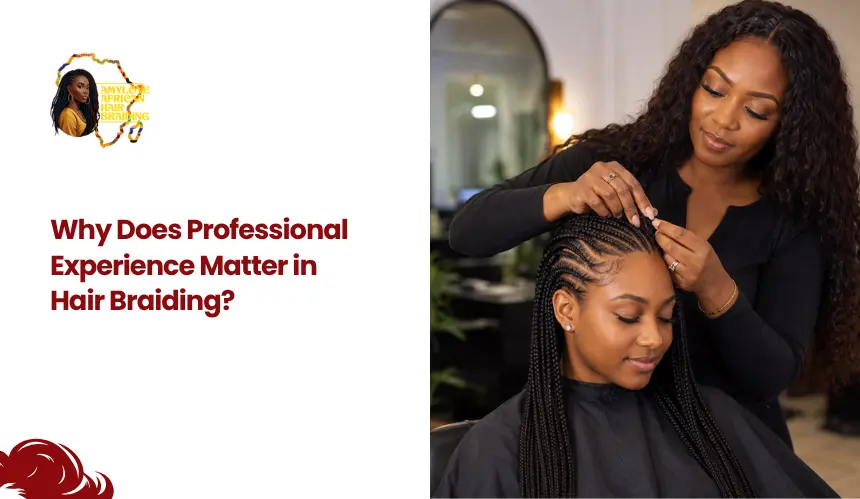
Why Does Professional Experience Matter in Hair Braiding?
Key Takeaways
|
Hair braiding may look straightforward, but poor technique often leads to scalp pain, breakage, and styles that fail within days. The difference usually comes down to the braider’s level of professional experience, which directly affects tension control, sectioning precision, and overall hair protection. Inexperienced handling can compromise both appearance and long-term hair health, especially with complex or protective styles.
Understanding how experience influences results helps avoid costly mistakes and unnecessary damage. This blog breaks down why professional expertise plays a critical role in achieving safe, durable, and well-executed braids.
What Problems Arise When Hair Braiding Lacks Professional Experience?
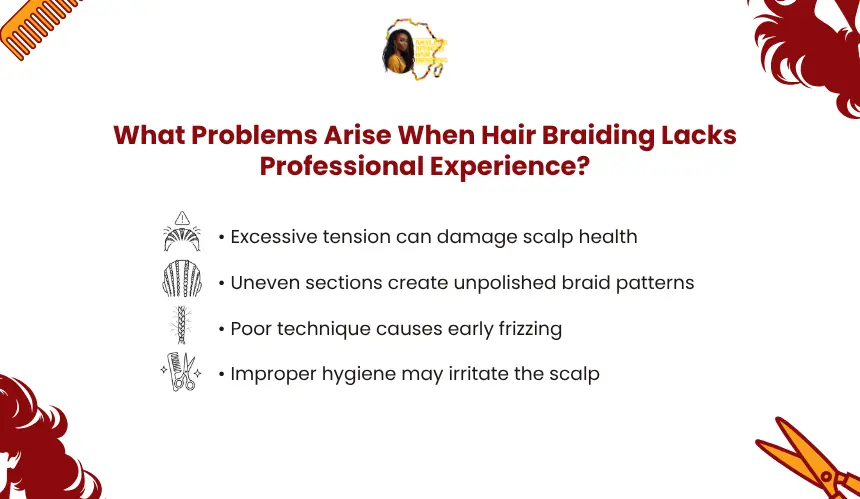
When braiding is performed without proper training or hands-on experience, execution errors translate directly into visible flaws and long-term hair issues. These problems are not cosmetic alone; they often affect scalp health, hair integrity, and how long the style remains wearable.
Scalp Damage and Tension-Related Hair Loss
Inexperienced braiders often apply inconsistent or excessive tension during installation, especially around edges and high-stress zones. This places continuous strain on hair follicles, increasing the risk of traction alopecia. Over time, repeated tension can weaken follicle anchoring, leading to thinning edges and, in severe cases, permanent hair loss.
Uneven Braids and Poor Sectioning Accuracy
Lack of control in parting and sectioning results in irregular braid sizes and inconsistent spacing. This disrupts the structural balance of the style, making it appear unpolished and asymmetrical. Uneven sections also distribute tension unevenly, which can create localized stress points across the scalp.
Reduced Style Longevity and Early Frizzing
Improper braiding technique affects how tightly and securely the hair is interwoven. Loose anchoring at the roots or inconsistent braid patterns cause premature unraveling and frizz formation. As a result, styles lose their neatness within days instead of maintaining structure for weeks.
Hygiene Issues and Improper Product Use
Inexperienced practitioners may overlook sanitation protocols or misuse styling products without understanding scalp compatibility. Excessive product buildup, use of low-quality extensions, or unclean tools can lead to scalp irritation, itching, and increased risk of infections.
How Professional Experience Improves Braiding Technique and Precision
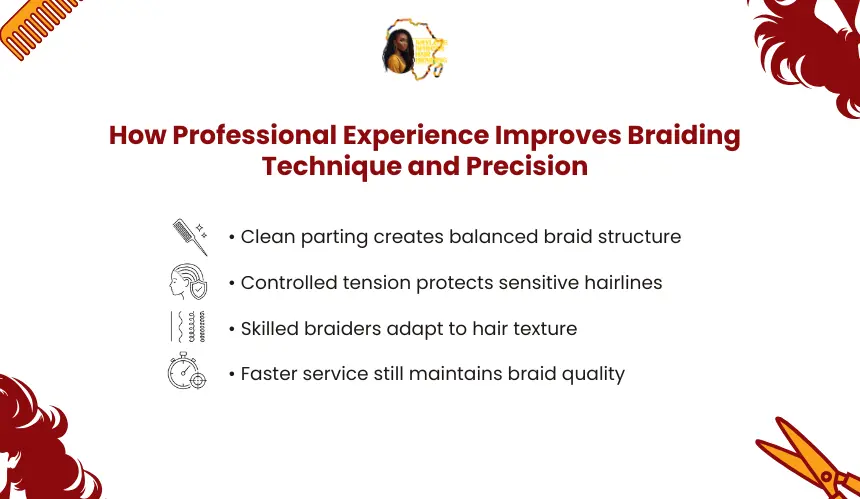
Experienced braiders operate with refined control over structure, tension, and pattern consistency, which directly determines how clean and stable the final style appears. Their technique is not based on repetition alone but on developed hand control, visual alignment, and adaptability during the braiding process.
Consistent Parting and Clean Sectioning Methods
Precise sectioning creates the foundation for uniform braids. Skilled braiders use sharp parting techniques and controlled spacing to ensure each section aligns proportionally across the scalp. This consistency enhances symmetry, improves visual neatness, and ensures that the style maintains its structure from all angles.
Balanced Tension Control for Scalp Safety
Professional experience allows braiders to regulate pulling force based on scalp sensitivity and hair strength. Instead of applying uniform tightness, they adjust tension dynamically across different zones, particularly around fragile areas like the hairline. This prevents discomfort while maintaining braid security.
Adaptation to Different Hair Textures and Densities
Hair behavior varies significantly based on texture, porosity, and density. Experienced braiders adjust grip, product usage, and braid size to match these variables. This prevents slippage in softer textures and avoids excessive strain in denser or coarser hair, ensuring better hold and durability.
Speed Without Compromising Braid Quality
Efficiency in braiding comes from muscle memory and process optimization, not rushed execution. Skilled braiders maintain consistent technique even at higher speeds, reducing appointment time while preserving accuracy in sectioning, tension, and braid alignment.
Why Experience Directly Affects Hair Health and Scalp Protection
Pain, tightness, itching, or sudden hair shedding after braiding are usually signs of incorrect installation or poor scalp preparation. These issues occur when the braider fails to account for scalp condition, hair strength, and moisture balance before and during the process.
The American Academy of Dermatology gives a simple warning sign for clients: if a braided style feels painful, it is too tight. Pain, stinging, crusting, or scalp “tenting” should be treated as early signs that the style needs to be loosened or removed.
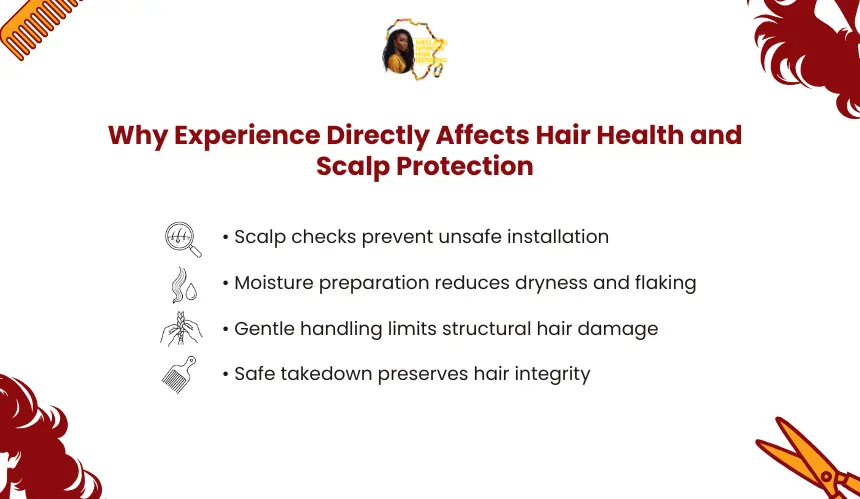
Accurate Pre-Braiding Assessment of Scalp and Hair Condition
Experienced braiders evaluate factors such as scalp inflammation, dryness levels, and strand elasticity before starting. This assessment influences decisions on braid density, extension weight, and whether the hair is suitable for a protective style at all. Skipping this step increases the risk of installing braids on already compromised hair.
A 2025 clinical review in StatPearls notes that traction alopecia can be reversible in its early stage, but repeated pulling from tight braids may progress into permanent scarring hair loss if the tension continues. |
Moisture Retention and Scalp Environment Management
Braided styles can either lock in hydration or accelerate dryness depending on preparation and product layering. Skilled professionals apply moisture-sealing techniques that maintain hydration beneath the braids without clogging follicles. Poor preparation often leads to dryness, itching, and flaking within the first week.
Controlled Manipulation to Prevent Structural Hair Damage
Hair fibers are most vulnerable during handling, especially when detangling and integrating extensions. Experienced braiders minimize mechanical stress by working with the natural direction of the hair cuticle and avoiding unnecessary pulling. This reduces internal fiber damage that typically results in split ends and mid-length breakage.
Safe Takedown Practices That Preserve Hair Integrity
The removal phase determines whether the hair retains its strength after weeks in a braided style. Professionals follow systematic takedown methods, including loosening buildup and detangling in stages, to prevent knot formation and excessive shedding. Improper removal often causes more damage than the installation itself.
How Experienced Braiders Customize Styles for Better Results
Professional experience allows braiders to move beyond standard patterns and tailor each style to the individual. Customization ensures the braids not only look appropriate but also align with the client’s hair characteristics, lifestyle demands, and maintenance capacity.
Face Shape and Style Suitability Considerations
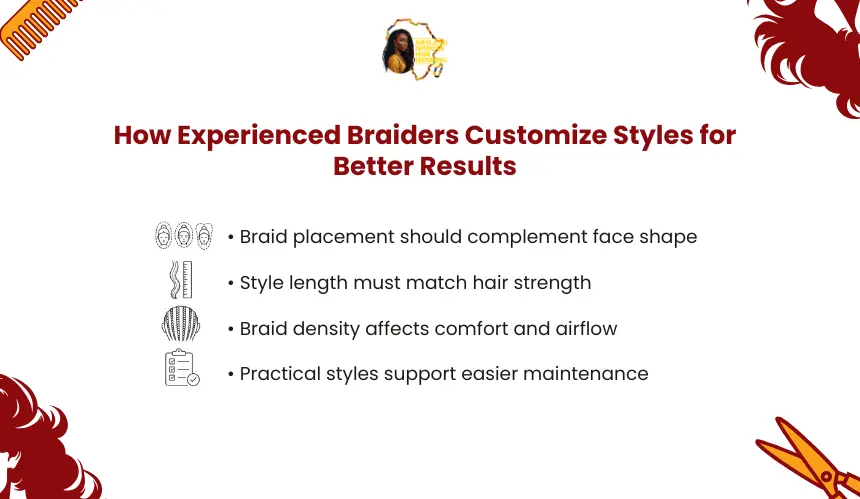
Experienced braiders adjust braid placement, parting patterns, and volume distribution based on facial structure. For example, certain braid directions or sizes can soften sharp features or add balance to longer face shapes. Without this consideration, even technically correct braids can appear visually disproportionate.
Hair Length, Thickness, and Style Feasibility Assessment
Not every braid style is structurally suitable for every hair type. Skilled professionals evaluate whether the natural hair can support the desired length, weight, and extension type without strain. This prevents overloading fine or short hair, which often leads to slippage or root stress.
Adjusting Braid Size, Pattern, and Density
Customization involves modifying braid thickness, spacing, and overall density to achieve both aesthetic balance and scalp comfort. Experienced braiders avoid overcrowding the scalp, which can restrict airflow and increase tension accumulation. Proper spacing also improves flexibility and reduces long-term stress on follicles.
Blending Aesthetics With Practical Maintenance
A well-designed braid style must remain manageable after installation. Professionals factor in daily routines, activity levels, and maintenance habits when recommending styles. This ensures the braids retain their appearance without requiring excessive upkeep or frequent adjustments.
What Should You Look For When Choosing an Experienced Braider?
Selecting a braider should be based on verifiable skill indicators rather than price or convenience alone. Experience shows up in consistent results, structured consultations, and professional standards that reduce risk and improve outcome reliability.
1. Portfolio Quality and Consistency Across Styles
A credible portfolio demonstrates uniform parting, clean lines, and consistent braid thickness across multiple clients and styles. Look for close-up images that reveal scalp visibility, edge work, and finishing quality. Inconsistent results across photos usually indicate gaps in technique rather than styling variation.
2. Client Reviews and Repeat Customer Patterns
Feedback that mentions comfort during installation, durability over weeks, and smooth takedown processes reflects real performance, not just appearance. Repeat clients are a strong signal of reliability, as they indicate the braider consistently delivers results without causing damage or discomfort.
3. Consultation Process and Communication Clarity
Experienced professionals conduct brief but focused consultations to assess hair condition, clarify expectations, and recommend suitable styles. Clear communication about tension, braid size, maintenance, and limitations prevents mismatched outcomes and reduces the likelihood of post-installation issues.
4. Clean Workspace and Professional Hygiene Standards
Tool sanitation, organized workspaces, and proper handling of extensions directly affect scalp health. An experienced braider maintains hygiene protocols to prevent contamination, product buildup, and irritation. Poor hygiene practices increase the risk of itching, infections, and long-term scalp complications.
Frequently Asked Quetions
How long should braids feel tight after installation?
Braids may feel slightly firm for the first day, but sharp pain, burning, scalp bumps, or difficulty moving the face are warning signs. Healthy braids should settle quickly without constant discomfort. If tightness lasts beyond 24–48 hours, the style may be placing excessive stress on the follicles.
What should I ask a braider before booking an appointment?
Ask how they assess scalp sensitivity, choose braid size, manage tension, sanitize tools, and handle different hair textures. A skilled braider should explain style limits clearly instead of promising every look for every hair type. Strong answers show technical judgment, not just styling ability.
Can people with thin or fine hair safely get braids?
Fine or thin hair can be braided safely when the style is adjusted for lower tension, lighter extensions, and larger support sections. Small, heavy, or tightly packed braids can overload weaker roots. A professional should recommend braid sizes and lengths that match the hair’s actual density.
Why do my edges hurt more than the rest of my scalp?
Edges usually hurt more because the hairline has finer strands, lower density, and less structural support than thicker scalp areas. Pain around the edges often means the braids are too tight, too heavy, or anchored too close to the skin. A skilled braider should reduce extension weight, use larger sections, and apply lighter tension around the hairline to prevent edge thinning and traction-related damage.
How often should I take a break between braided styles?
Most people benefit from giving the scalp and hair a short recovery period between braided styles, especially after long wear. A break of at least one to two weeks allows shedding hair to release, moisture balance to recover, and the scalp to calm before another tension-based style.
What are signs that a braided style should be removed early?
Braids should be removed early if there is persistent pain, scalp swelling, crusting, excessive itching, visible bumps, or sudden hair shedding near the roots. These signs suggest the style is stressing the scalp instead of protecting the hair. Waiting too long can increase breakage risk.