What Hair Length Is Ideal For Goddess Braids?
Key Takeaways:
|
Can Goddess Braids Be Done on Short Hair?
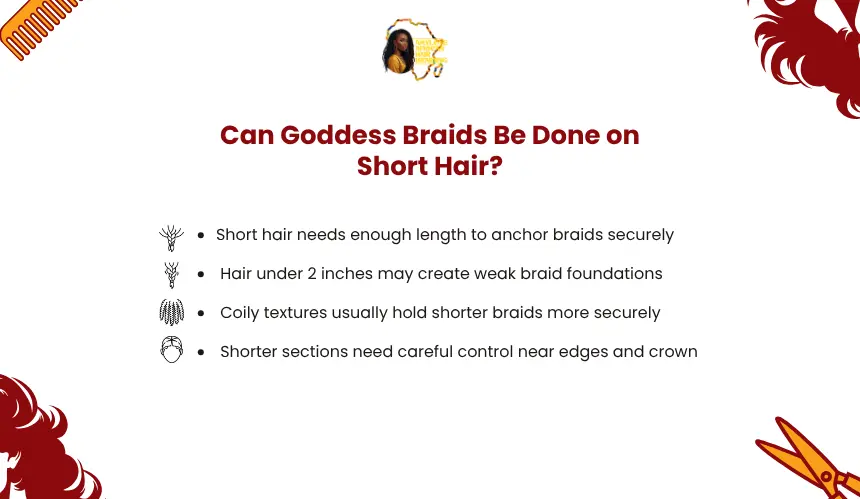
Yes, goddess braids can be installed on short hair, but the hair still needs enough length to anchor the braid securely at the root. Hair shorter than roughly 2 inches often creates weak braid foundations because the strands cannot wrap tightly around extension hair during installation.
Short natural hair also limits section control, especially near the edges and crown area where smaller strands tend to loosen first. Coily and tightly textured hair generally performs better at shorter lengths because the natural curl pattern creates friction that helps the braid stay locked in place. Straighter textures usually require additional length or styling products to prevent slipping.
Recommended Starting Hair Length for Goddess Braids
Hair that measures around 4 to 6 inches usually creates the most balanced starting point for goddess braids. This range gives stylists enough working length to form secure braid bases without relying on excessive tension or heavy product application.
At this length, the natural hair blends more smoothly into extension hair, which improves braid appearance and reduces visible separation near the roots. Medium-length hair also supports cleaner parting patterns and helps larger braid designs maintain their structure for a longer period.
Why Hair Texture Also Affects Braiding Results
Hair texture affects braid grip just as much as hair length. Tightly curled and coarse textures typically hold goddess braids more effectively because the strands naturally interlock during braiding.
Straight, silky, or heavily relaxed hair behaves differently because smoother strands separate more easily under tension. Stylists often compensate by using smaller sections, grip-enhancing products, or tighter braid patterns to improve stability.
Hair density also matters because fine or low-density hair may struggle to support large goddess braids even when the overall length appears adequate.
What Hair Length Works Best for Fuller and Longer-Lasting Goddess Braids?
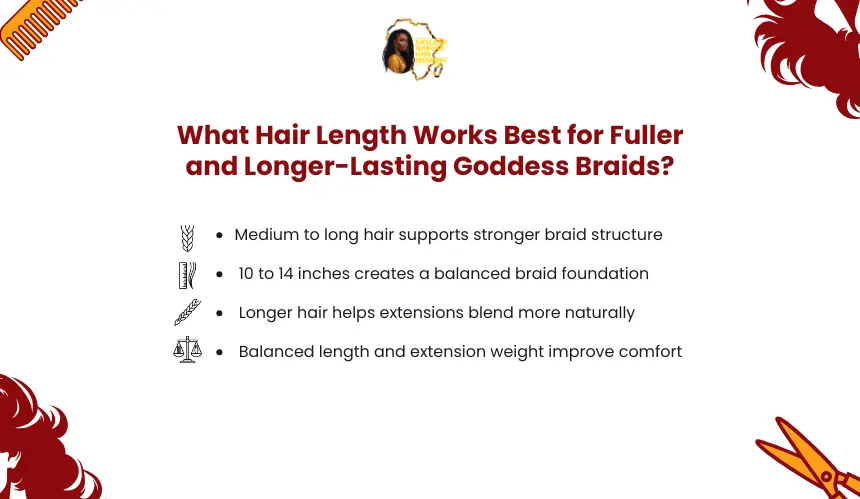
Hair that falls within the medium to long range usually creates the best results for goddess braids because it supports stronger braid structure, smoother blending, and better weight distribution. While shorter hair can still be braided, longer natural hair generally produces fuller-looking braids with improved durability and more styling flexibility.
Ideal Hair Length for Medium Goddess Braids
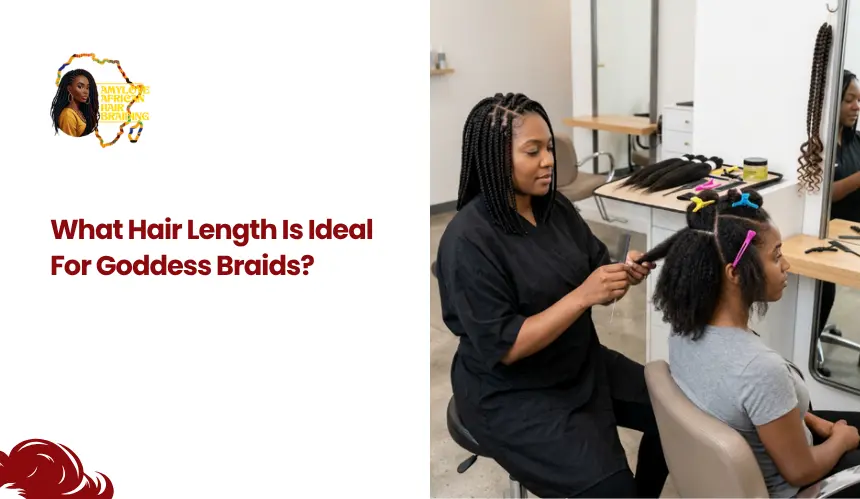
Hair that measures roughly 10 to 14 inches typically creates the most balanced foundation for medium goddess braids. This length gives stylists enough natural hair to build secure braid tension, maintain smoother blending with extensions, and create fuller braid patterns without placing excessive stress on the scalp.
This range also supports more consistent braid thickness from root to ends. When the natural hair distributes evenly through the braid, the final style appears cleaner and more structured instead of bulky near the base and thinner toward the ends.
Medium-length hair also reduces reliance on heavy extension hair, which helps minimize scalp strain and improve long-term comfort.
How Longer Hair Changes the Final Look
Longer natural hair allows goddess braids to appear fuller because more natural strands contribute to the braid structure throughout the installation. This creates better density distribution and reduces visible gaps within larger braid patterns.
Long hair also increases styling versatility. Stylists can create larger feed-in designs, waist-length braid styles, braided updos, or layered braid patterns without compromising stability near the roots.
In many cases, longer natural hair improves how naturally the extensions blend, especially when using textured braiding hair that matches the client’s curl pattern or density.
Does Longer Hair Make Goddess Braids Last Longer?
Longer hair often improves braid longevity because the braid base remains more secure as the style ages. Additional length creates more surface area for the natural hair to wrap around extension fibers, which strengthens the overall braid structure and reduces early loosening.
However, excessive length combined with heavy extensions can increase tension on the scalp if the braid size is not adjusted properly. Very long hair also requires more consistent maintenance because product buildup, frizz, and root expansion become more noticeable over time.
The most durable goddess braid results usually come from balancing natural hair length, extension weight, and braid size rather than maximizing length alone.
How Extensions Affect Hair Length Requirements For Goddess Braids
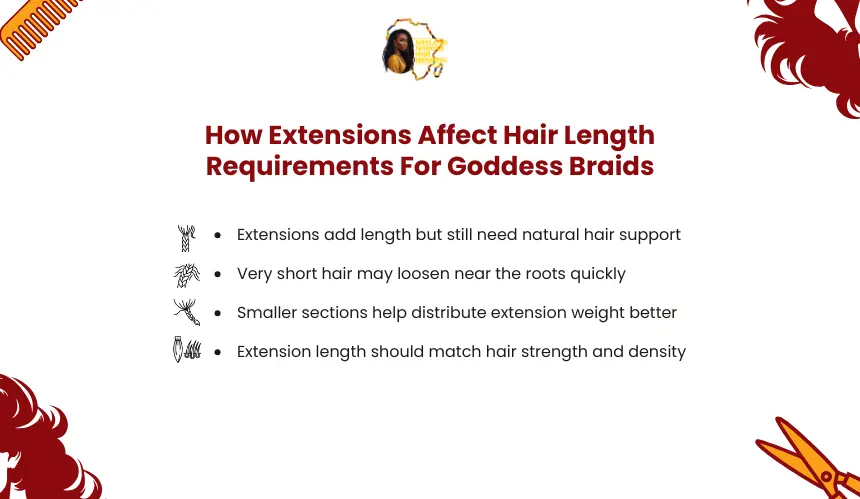
Extensions can increase braid length and fullness, but they do not eliminate the need for sufficient natural hair underneath. Goddess braids still depend on the natural hair to anchor the braid at the scalp, stabilize tension, and support the added extension weight during daily movement and wear.
Can Extensions Compensate for Short Natural Hair?
Extensions can help create goddess braids on shorter hair, but they cannot fully compensate for extremely limited natural length. If the base hair is too short, the braid lacks enough anchor points to hold the extension securely, which increases the risk of loosening near the roots.
Stylists often adjust braid size when working with shorter hair to reduce tension and improve grip. Smaller sections typically perform better because they distribute extension weight more evenly across the scalp. Larger goddess braids on very short hair may pull excessively at the roots, especially around fragile edge areas.
Choosing Extension Length Based on Natural Hair
Extension length should match the strength and density of the natural hair supporting it. Shorter or finer natural hair generally performs better with moderate extension lengths because extremely long braids create additional downward force on the roots.
For example, shoulder-length natural hair can usually support longer goddess braid styles more comfortably than hair that barely reaches the neck. Extension texture also matters because lighter synthetic fibers or textured braiding hair often blend more naturally and place less strain on the braid foundation.
When Short Hair Creates Braiding Challenges
Very short natural hair creates structural challenges during goddess braid installation because the strands separate more easily under tension. This often leads to exposed roots, frizz near the braid base, or sections that loosen unevenly after a short period of wear.
Short hair also limits how smoothly the stylist can feed extension hair into the braid pattern. In curved braid designs or larger scalp patterns, insufficient length may create visible inconsistencies between braid sections. Hairline areas are especially vulnerable because repeated tension on shorter strands can increase stress around the edges and temples over time.
How to Know If Your Hair Is Ready for Goddess Braids
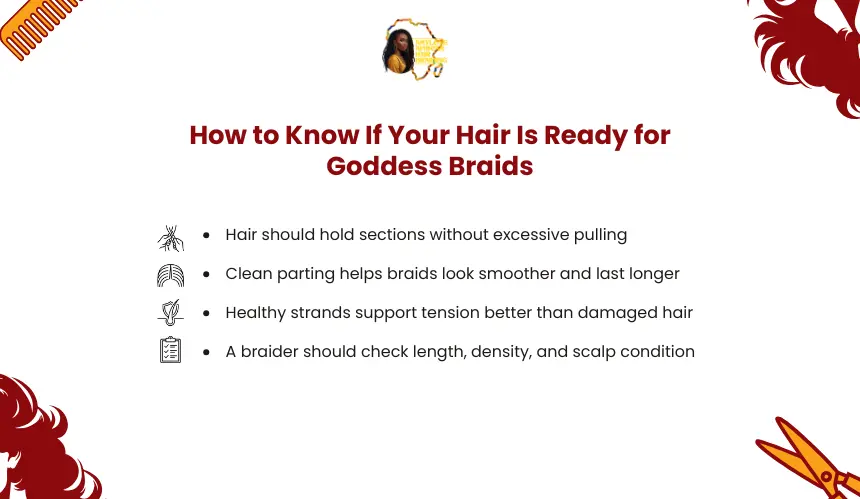
Hair is usually ready for goddess braids when it has enough length, strength, and density to support consistent braid tension without excessive pulling or breakage. Length alone does not determine readiness because weak strands, damaged edges, or uneven density can affect how securely the braids hold and how comfortably the style wears over time.
Signs Your Hair Length Is Suitable
Hair is generally suitable for goddess braids when the stylist can grip each section securely without relying on excessive tension or heavy product buildup. A stable braid foundation should remain consistent from the root area through the first few inches of the braid without strands slipping out during installation.
Another indicator is section control. When the natural hair can be parted cleanly and distributed evenly into braid sections, the final style tends to appear smoother and last longer. Hair that constantly separates, shrinks excessively during braiding, or exposes the scalp unevenly often requires additional growth before larger goddess braid styles can be installed effectively.
Hair Health Factors That Matter More Than Length
Strong hair health often matters more than maximum length because damaged strands cannot support braid tension efficiently. Hair affected by excessive breakage, thinning edges, chemical overprocessing, or severe dryness may struggle to maintain braid stability even when the overall length appears adequate.
Scalp condition also affects installation quality. Irritated or inflamed scalp areas become more sensitive under braid tension, especially with heavier extension styles. Balanced moisture levels, reduced shedding, and stronger strand elasticity usually create better long-term braid retention and lower the risk of traction-related stress.
Questions to Ask a Braider Before Installation
A professional braider can usually determine whether the hair length and density are suitable within the first consultation. Asking about recommended braid size, extension weight, and scalp tension helps prevent styles that place unnecessary strain on shorter or weaker hair.
It is also useful to ask how the chosen braid pattern will interact with the current hair condition. Some feed-in styles, oversized goddess braids, or extra-long extensions require stronger braid foundations than smaller or medium-sized designs. A stylist who evaluates both hair length and structural health typically creates more balanced and longer-lasting results.
In Lakewood, WA, clients who commute along I-5, travel between Tacoma and Olympia, or live near Joint Base Lewis-McChord may prefer braid lengths that stay comfortable through long days, uniforms, workouts, or frequent movement.
A professional goddess braids stylist in Lakewood will usually evaluate extension weight, braid size, and natural hair density before installation to prevent excess scalp tension and improve long-term braid retention.
Hair length, braid tension, and extension balance all affect how goddess braids look and hold over time. AmyLove African Hair Braiding helps clients choose braid styles that match their natural hair condition, desired fullness, and long-term comfort so the final result feels secure, natural, and easier to maintain.
Frequently Asked Quetions
How long should natural hair be before getting goddess braids with curls?
Natural hair should ideally be at least 4 to 6 inches before getting goddess braids with curls because the braid base must hold both extension hair and loose curly pieces. Shorter hair may still work, but the stylist may need smaller sections, lighter extensions, or extra grip control to reduce slipping near the roots.
Can fine or thin hair safely hold goddess braids?
Fine or thin hair can hold goddess braids when the braid size and extension weight are adjusted carefully. Large or extra-long braids may place too much stress on low-density hair, especially around the edges. A lighter braid pattern, medium length, and controlled parting usually create a safer protective style.
Are goddess braids better on stretched or unstretched hair?
Goddess braids usually install more cleanly on stretched hair because the stylist can see the true length, create cleaner parts, and control tension more evenly. Unstretched curls may shrink during sectioning, which can make the braid base less predictable and increase frizz around the roots after installation.
What happens if my hair is too short for goddess braids?
Hair that is too short may not anchor extension hair securely, causing loose roots, exposed natural strands, or early unraveling. In some cases, forcing the style can create unnecessary scalp tension. A stylist may recommend waiting for more growth, choosing smaller braids, or selecting a lower-tension protective style first.
How do I know if goddess braids will be too heavy for my hair?
Goddess braids may be too heavy if the scalp feels tight, the roots pull when the hair moves, or the braids feel uncomfortable when tied up. Extension length, braid thickness, and natural hair density all affect weight distribution. A professional goddess braids stylist in Lakewood, WA can adjust the style before installation.
Should I trim damaged ends before getting goddess braids?
Trimming damaged ends before goddess braids can improve braid neatness and reduce tangling inside the style. Split ends, breakage, and dry strands can make the natural hair harder to blend with extensions. Healthy ends also lower friction during takedown, which helps protect length retention after the braids are removed.