
What maintenance tips help goddess braids stay neat longer?

Key Takeaways
|
Goddess braids are loved for their soft, stylish look, but keeping them neat takes more than just a fresh installation. Because the style includes both braided sections and loose curly pieces, it can lose its polished finish faster when exposed to friction, dryness, sweat, or buildup.
With the right care, goddess braids can stay cleaner, smoother, and more comfortable while maintaining their natural, elegant appearance for longer.
Why Goddess Braids Need Consistent Maintenance

Goddess braids can lose their polished look faster than traditional braids because they combine firm braided sections with soft, exposed curls. Without steady care, frizz, scalp buildup, and root loosening can make the style look older before it is ready to be removed
In Parkland, FL, a city known for its quiet residential communities, green spaces, and family-friendly lifestyle around areas like Pine Trails Park and Heron Heights, many clients prefer hairstyles that are both stylish and easy to maintain in warm, humid weather. This is why Fulani Braids in Parkland are often chosen, as the detailed braid patterns and optional bead accents offer a polished, expressive look while still being practical for everyday wear. The style is especially encouraged by the area’s active outdoor routines and social community events, where low-maintenance protective styles help maintain neatness and comfort for longer periods.
Why Are Loose Curly Ends More Prone To Frizz?
The curly ends in goddess braids are exposed instead of fully tucked into the braid, so they react more quickly to dryness, humidity, and friction. When the curls lose moisture or rub against clothing, pillows, or hands, the curl pattern can separate and create a fuzzy finish.
Product buildup can also weigh down the curls and make them look dull instead of defined. Light hydration and gentle handling help the loose ends keep their shape without becoming tangled or rough.
How Does Scalp Condition Affect The Overall Style?
The scalp plays a major role in how fresh goddess braids look. Dryness can cause flaking around the parts, while excess oil, sweat, and product residue can make the roots appear heavy or unclean.
Itching is another issue because scratching can disturb the braid base and loosen the neat parting. When the scalp stays balanced, clean, and lightly moisturized, the braids usually hold their shape better.
Why Does Nighttime Friction Shorten The Neat Look?
Nighttime friction is one of the fastest ways goddess braids become frizzy. Cotton pillowcases absorb moisture and create rough contact against the braids, which can lift flyaways and disturb the loose curls.
Without a smooth sleep barrier, the braids can shift out of place and the loose curls may lose their shape by morning. A covered style stays more controlled overnight and needs less correction the next day.
In Parkland, FL, where daily routines often include time spent around community spaces like Quigley Park and nearby residential activity hubs, many clients look for hairstyles that stay neat, lightweight, and easy to manage in warm, humid conditions. This is why Knotless Braids in Parkland are often chosen, as the gradual braiding technique reduces tension at the scalp while creating a smooth, natural flow that suits both casual outings and busier days. The style’s comfort and low-maintenance appeal make it especially practical for people who want a polished look without constant daily styling.
Daily Habits That Keep Goddess Braids Looking Fresh

Daily care should focus on preserving shape with minimal handling. Simple routines like loose wrapping, light curl refreshing, and selective smoothing help the style stay controlled without disturbing the braid pattern.
With Parkland, FL, known for its warm weather, outdoor lifestyle, and active community spaces like Pine Trails Park and Terramar Park, many clients look for protective hairstyles that stay stylish while remaining manageable in humid conditions. Many people choose Goddess Braids in Parkland because the style combines neat braided sections with soft curly ends that create a lighter, more elegant look suitable for both everyday wear and social events around the area. The style is also popular for helping reduce daily hair manipulation while maintaining a polished appearance throughout Parkland’s active and climate-driven lifestyle.
How Should Goddess Braids Be Covered Before Sleeping?
Goddess braids should be secured before bed with a satin bonnet, silk scarf, or satin pillowcase. These options keep the style contained overnight so the braids do not shift, bend, or press unevenly while sleeping.
The braids should also be tied loosely instead of pulled into a tight bun or ponytail. Loose wrapping keeps tension away from the edges while preventing the curls from rubbing against bedding, clothing, or each other overnight.
How Can Curly Ends Be Refreshed Without Making Them Frizzy?
Curly ends should be refreshed with a light amount of leave-in spray, curl mousse, or braid-safe moisturizer. The product should be applied in small sections so the curls regain shape without becoming overly wet or sticky.
Too much water can cause the loose curls to swell, separate, or tangle. A light mist followed by gentle finger shaping is usually enough to restore definition while keeping the goddess braid style controlled and polished.
How Can Flyaways Be Smoothed Without Heavy Product?
Flyaways can be managed with a small amount of light mousse, braid sheen spray, or edge control applied only where needed. This keeps the surface smooth without coating the entire braid with thick product.
Thick gels and wax-based products can harden around loose hairs, making the braid surface look stiff instead of clean and soft. A small amount of product should be used only on visible flyaways so the braid surface stays flexible instead of coated or stiff.
Scalp Care Tips That Extend The Style

Scalp care helps preserve comfort and part visibility, especially as natural oils, sweat, and new growth begin to change how the style sits. The focus should be targeted care, not heavy product use across the entire style.
How Can The Scalp Stay Moisturized Without Becoming Greasy?
The scalp should be moisturized with lightweight scalp oil, hydrating spray, or a water-based braid spray applied directly along the parts. This targets dryness at the scalp level while keeping the braid length light and natural-looking.
A few targeted drops are usually enough because over-application can make the scalp look shiny, heavy, or coated. A controlled application keeps the scalp comfortable while helping the parting pattern remain cleaner and more defined.
How Should Sweat And Buildup Be Controlled Early?
Sweat should be addressed soon after workouts, outdoor activity, or long humid days. A soft clean cloth can be used to gently pat the scalp, especially around the hairline, crown, and part lines where moisture tends to collect first.
Applying products over sweat can trap residue close to the scalp and make the parts look dull. Gentle wiping after activity keeps the area cleaner without forcing a full wash.
Why Should Scratching Or Pulling At The Roots Be Avoided?
Scratching can lift the braid base, blur clean parts, and create small frizzy strands near the scalp. It can also irritate sensitive areas, making the style less comfortable even when the braids still look wearable.
Repeated pulling can make the natural hair feel strained beneath the braid. If itching does not settle, a cooling scalp spray, gentle tapping, or stylist check is safer than constant root manipulation.
Washing And Refreshing Goddess Braids The Right Way
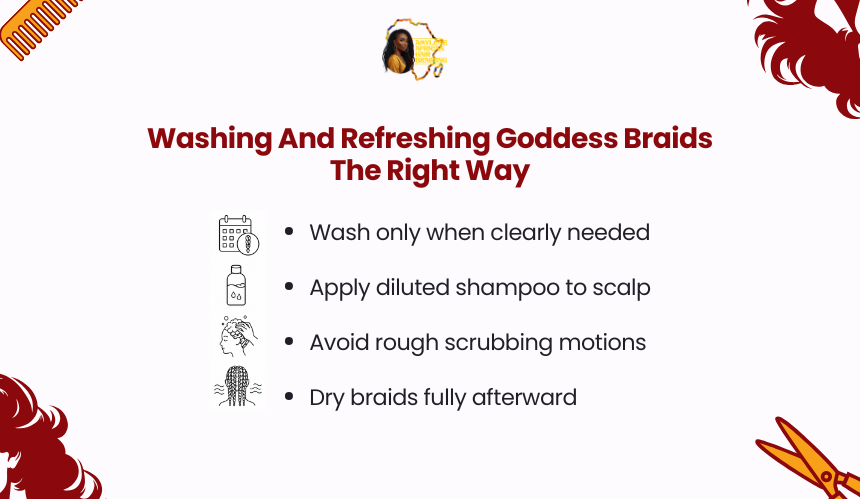
Washing goddess braids should be done with limited movement and a scalp-first method. This allows cleansing without soaking the style more than necessary or roughening the finished look.
When Should Goddess Braids Be Washed?
Goddess braids should be washed only when the scalp shows clear signs that cleansing is needed, such as sweat buildup, odor, heaviness, or visible residue along the parts. Washing too often can soften the braid base and cause the style to lose its firm hold earlier.
For mild discomfort, a scalp refresher or gentle wipe-down may be enough between full washes. This reduces unnecessary manipulation while keeping the style more comfortable and hygienic.
How Should Shampoo Be Applied To Goddess Braids?
Shampoo should be diluted with water before application so it spreads easily across the scalp without leaving concentrated residue. The cleanser should be applied mainly to the parts and roots, where oil, sweat, and dirt collect first.
Gentle fingertip pressure is better than rough scrubbing because aggressive movement can blur the parts and make the surface look fuzzy. The braid length should be rinsed carefully instead of being rubbed, twisted, or squeezed harshly.
Why Is Complete Drying Important After Washing?
Goddess braids must dry fully after washing because trapped moisture can create odor, scalp discomfort, and mildew-like concerns inside thick braided sections. Blotting with a towel first removes excess water without disturbing the style.
After blotting, the braids can air dry in a well-ventilated space or be placed under a hooded dryer on a comfortable setting. The style should not be tied up or covered while damp, since restricted airflow slows drying and can make the braids feel heavy.
Mistakes That Make Goddess Braids Look Old Faster
Some maintenance habits shorten the clean appearance of goddess braids even when the installation was done well. Most early wear comes from excess tension, product overload, or delayed correction once the style starts changing.
Why Does Too Much Oil Or Styling Product Make Goddess Braids Look Messy?
Too much oil, cream, gel, or shine spray can leave a visible coating on the scalp and braid surface. Once that coating mixes with lint, dust, sweat, or dead skin cells, the parts can look cloudy instead of crisp.
Heavy product also affects the loose curl pieces by reducing bounce and definition. Instead of looking soft and separated, the curls may clump, flatten, or feel sticky, which makes the style appear older than it is.
How Do Tight Ponytails Affect Goddess Braids?
Tight ponytails, high buns, and pulled-back styles place repeated stress on the roots and edges. This tension can make the braid base shift, loosen, or pull away from the scalp faster.
Frequent tight styling can also cause soreness around the hairline and increase strain on fragile edge areas. Wearing goddess braids in loose, low-tension styles protects the installation while keeping the scalp more comfortable.
Do You Know? According to Clinical, Cosmetic and Investigational Dermatology, traction alopecia affects about one-third of women of African descent who wear high-tension or traumatic hairstyles for long periods. This makes low-tension styling especially important for goddess braids because tight ponytails, heavy buns, and repeated pulling can stress the hairline before visible damage appears. |
Why Should Frizz Be Managed Before It Spreads?
Small frizz is easier to control when it is handled early. Light smoothing, careful curl shaping, and trimming tiny stray extension fibers can prevent rough areas from spreading across the braid surface.
Waiting too long allows flyaways to catch on nearby curls, clothing, and accessories. Once the frizz expands, the style becomes harder to refresh without a touch-up, especially around the front, crown, and loose curly ends.
When To Touch Up Or Remove Goddess Braids
Maintenance can improve the look of goddess braids, but some changes signal that the style needs either a small correction or full removal. The decision depends on whether the issue is cosmetic, structural, or uncomfortable enough to affect the natural hair underneath.
What Signs Show Goddess Braids Need A Touch-Up?
A touch-up may be enough when the main issues are limited to the front hairline, loose edge braids, frizzy part lines, or a few curls that have started to tangle. These problems usually affect appearance before they affect the style’s overall structure.
Braids slipping from the root, visible scalp residue, or uneven curly pieces can also make the style look less refined. A stylist may refresh the perimeter, clean up selected parts, redefine the ends, or secure loose sections without removing every braid.
When Should Goddess Braids Be Removed Completely?
Goddess braids should be removed when the scalp becomes irritated, sore, or persistently uncomfortable. Heavy matting near the roots, strong odor after cleansing, or excessive new growth can make safe maintenance difficult.
Removal is also the better option when the braids feel too tight, too heavy, or unstable at the base. Keeping the style past this point can increase tangling, stress the natural hair, and make the takedown process harder.
Do You Know? According to the American Academy of Dermatology Association, shedding 50 to 100 hairs per day is considered normal. Over four weeks, that can equal around 1,400 to 2,800 naturally shed hairs, which may stay trapped inside goddess braids until takedown. Seeing shed hair during removal does not always mean the style caused damage. |
How Long Do Goddess Braids Usually Stay Neat?
Goddess braids usually stay neat for a few weeks, but the exact timeline depends on hair texture, braid size, scalp oil production, activity level, and care routine. Smaller braids may hold shape longer, while larger braids can show root changes sooner.
A consistent routine can extend the wearable period, but the style should still be judged by how secure, manageable, and healthy it feels.However, once the roots lose structure or the curls become difficult to separate, maintenance has reached its limit.
Do You Know? NCBI Bookshelf, StatPearls notes that scalp hair grows about 0.35 mm per day, which equals roughly 0.5 inch per month or 6 inches per year. This explains why goddess braids may start showing root changes after a few weeks, even when the braids are still clean and well maintained. |
Frequently Asked Quetions
Can someone work out regularly with goddess braids?
Goddess braids can work for active routines, but sweat management becomes more important. After workouts, the scalp should be cooled, lightly blotted, and allowed to air out before adding any product. Tight gym buns should be avoided because repeated tension can weaken the roots and stress the hairline.
Are goddess braids a good choice for humid weather?
Goddess braids can handle humid weather, but the loose curly pieces may expand faster than the braided sections. A humidity-conscious routine should focus on lightweight curl mousse, minimal water use, and protective nighttime wrapping. In warm climates, scalp freshness and curl separation usually determine how polished the style looks.
Can goddess braids damage natural hair?
Goddess braids are generally protective when installed with proper tension and removed on time. Damage risk increases when braids are too tight, too heavy, left in too long, or repeatedly pulled into high styles. The safest approach is to monitor scalp soreness, edge sensitivity, matting, and root pressure.
Why do goddess braids itch after a few days?
Itching may come from scalp dryness, sweat, product residue, tight installation, or sensitivity to synthetic hair. Mild itching can often be managed with a light scalp spray or gentle tapping. Persistent burning, bumps, soreness, or flaking may signal irritation and should not be ignored.
Can goddess braids be refreshed without going back to the stylist?
Minor refreshing can be done at home if the braids are still secure. Light mousse, careful curl separation, edge smoothing, and trimming tiny stray extension fibers can improve the finish. A stylist is better for loose perimeter braids, slipping roots, heavy tangling, or uneven curly ends.