How Do Salons Ensure Consistent Braid Quality?
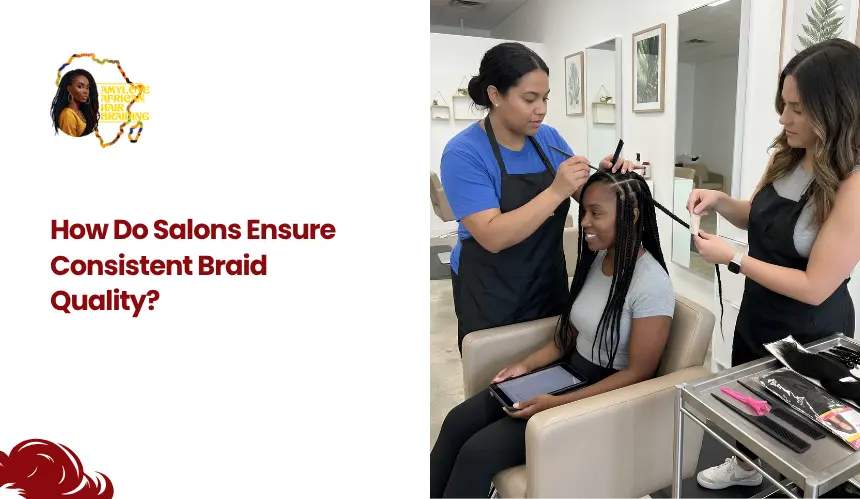
Achieving consistent braid quality is one of the most difficult operational challenges in a salon setting. Variations in hair texture, stylist technique, and execution speed can quickly lead to uneven results, even within the same appointment. Clients, however, expect uniform sizing, balanced tension, and long-lasting braids every time.
This gap between expectation and execution is addressed through structured systems rather than individual skill alone. This blog breaks down how professional salons maintain that level of precision across every braid service.
Why Maintaining Consistent Braid Quality Is Challenging in Salon Environments
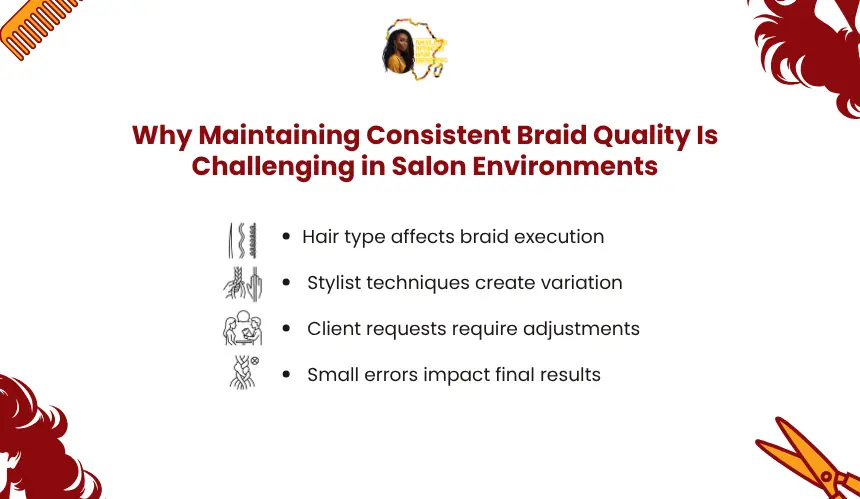
Consistency in braiding is not a fixed outcome. It is a controlled response to multiple variables that change with every client, stylist, and service condition.
- Hair variability directly affects execution: Differences in curl pattern, strand thickness, density, and scalp sensitivity influence sectioning accuracy and tension control. Techniques must be adjusted without disrupting overall braid uniformity.
- Stylist technique variation impacts final results: Small differences in hand positioning, pulling angle, and braiding rhythm can lead to uneven sizing, misalignment, or inconsistent tightness if not actively standardized.
- Client expectations introduce controlled flexibility: Requests for specific sizes, patterns, or tension levels must align with what the hair can structurally support, requiring adaptation without compromising consistency.
- Operational pressure affects precision: Time constraints, appointment volume, and workstation setup can reduce accuracy if processes are not systematized and repeatable.
- Cumulative effect of small inconsistencies: Minor deviations in sectioning or tension, when repeated across the head, create visible inconsistencies that impact overall braid quality.
These factors make consistency a managed process, requiring salons to actively control variability rather than rely solely on individual skill.
Techniques and Training Used by Salons for Consistent Braid Quality
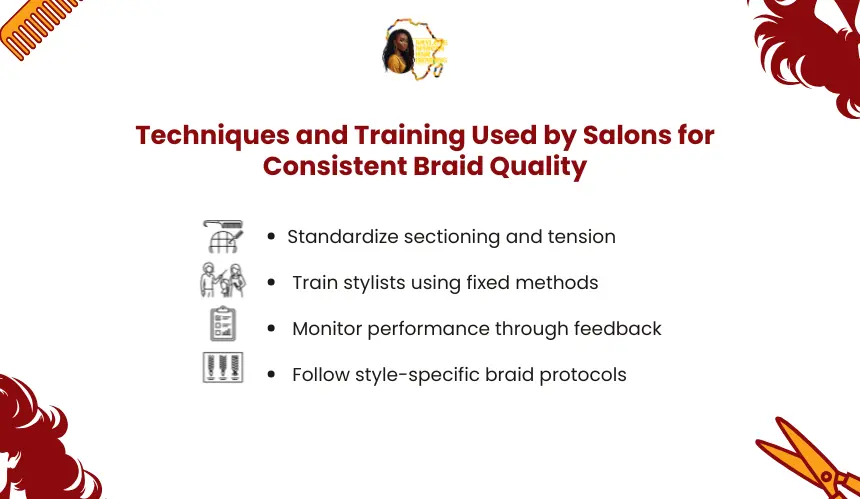
Consistency in braid quality is achieved through controlled execution systems, not individual stylist variation. Salons define how braiding should be performed and reinforce those standards through structured training, ensuring every stylist follows the same technical framework.
Standardizes Braiding Techniques Across Stylists
Uniform results depend on eliminating variation in core steps such as sectioning, parting, and tension control. Salons implement fixed sectioning patterns to maintain equal braid size and spacing, while parting is executed using consistent angles and grid structures to avoid irregular layouts. Tension is also regulated to ensure braids remain secure without creating discomfort or uneven tightness.
Execution consistency is further reinforced by aligning hand positioning and braiding sequences. When stylists follow identical movement patterns and step order, the structure, alignment, and finish of each braid remain consistent regardless of who performs the service.
How Do Salons Maintain Stylist Performance Through Training Systems?
| For salons in Washington, the state’s Department of Licensing requires hair design apprenticeships to include 2,000 hours of on-the-job training and 144 hours of related supplemental instruction, which reinforces why supervised practice is central to consistent salon performance. |
Defined Protocols for Different Braid Styles
Each braid style has specific structural requirements, making a single method ineffective for all cases. Salons address this by assigning defined execution protocols to each braid type, ensuring predictable and repeatable results.
Box braids require structured grid sectioning to maintain even distribution and volume balance. Cornrows depend on consistent part direction and controlled proximity to the scalp for clean patterns.
Knotless braids rely on precise feed-in techniques to maintain smooth thickness progression without bulk. By standardizing the process for each style, salons ensure consistent outcomes regardless of variation in hair type or stylist.
How Salons Apply Quality Control Systems to Maintain Consistent Braid Quality
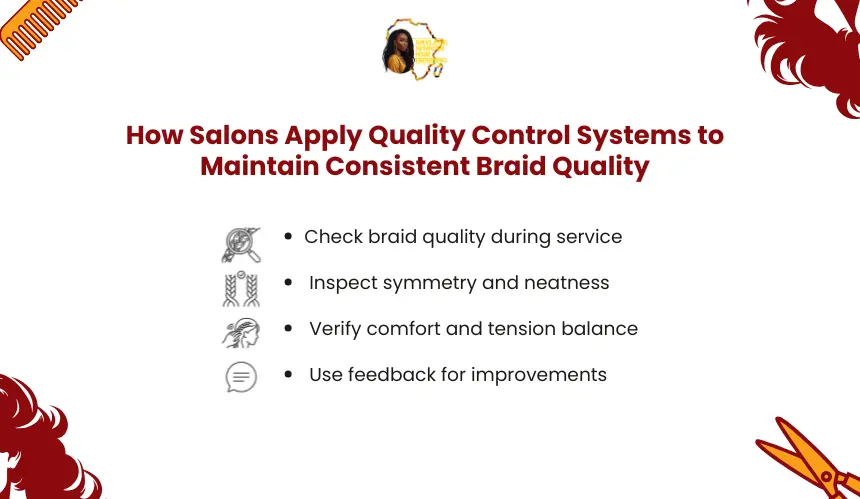
Standardized techniques reduce variation, but consistency is enforced through active quality control during and after the service. Salons that deliver uniform braid results continuously monitor execution and correct deviations before they affect the final outcome.
Perform Real-Time Quality Checks During Braiding
Quality control begins during the braiding process, not after completion. Stylists and supervisors monitor section symmetry, ensuring each part aligns with the intended grid and spacing. Braid size is checked continuously to prevent gradual inconsistencies across the head.
Tension is also evaluated in real time. Uneven pulling can lead to discomfort or structural imbalance, so adjustments are made immediately as braids are formed. Alignment and direction are tracked to maintain pattern consistency, especially in styles requiring precise layout, such as cornrows.
Post-Service Inspection Standards
Once braiding is complete, salons apply structured inspection criteria before finalizing the service. This includes verifying that braid sizes are uniform, parts are clean, and overall symmetry is maintained across the entire style.
The finish is assessed for neatness, including the smoothness of extensions, consistency at the roots, and the absence of loose or irregular strands. Scalp condition is also evaluated to ensure that the braids are secure without excessive tension, supporting both durability and client comfort.
A 2018 dermatology review found that traction alopecia affects about one-third of women of African descent who wear prolonged high-tension styles, making scalp comfort and tension checks just as important as visual braid neatness |
Client Feedback to Validate Braid Quality
Client feedback functions as an immediate validation layer for quality control. Salons assess comfort levels, particularly around tension and scalp sensitivity, to ensure the technical execution aligns with client expectations.
Feedback is also used to refine future services. If a client prefers adjustments in size, tightness, or style structure, those inputs are recorded and applied in subsequent appointments. This creates a feedback loop that strengthens consistency not just within a single service, but across repeated visits.
Tools, Products, and Setup to Maintain Consistent Braid Quality
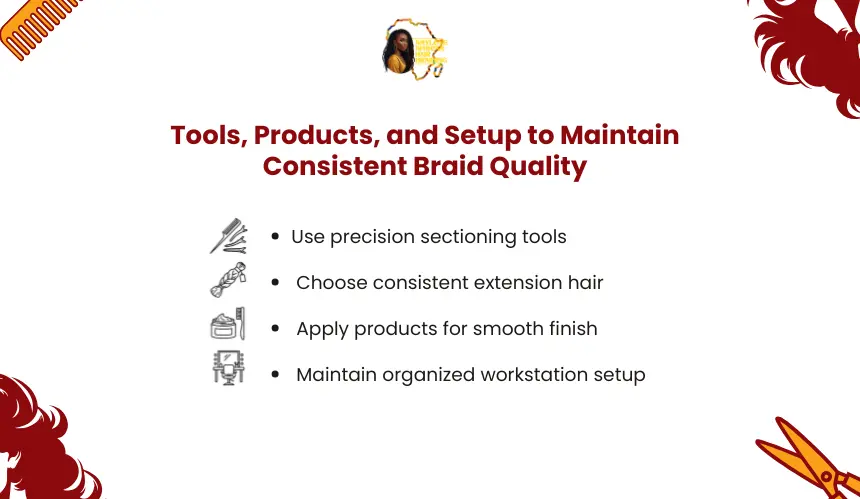
Even with standardized techniques and quality checks, inconsistent tools or materials can disrupt results. Salons control physical inputs by using uniform tools, verified hair materials, and a structured workstation setup to ensure every braid is executed under the same conditions.
How Do Professional Tools Support Precision in Braiding?
Precision tools directly influence section accuracy and alignment. Salons rely on specific tools to maintain clean parts, controlled sections, and consistent visual symmetry.
- Rat-tail combs for creating sharp, straight parting lines and precise section divisions
- Sectioning clips to isolate hair segments and prevent overlap during braiding
- Edge brushes or smoothing tools to refine hairlines and maintain clean section boundaries
- Professional mirrors (front and hand-held) to monitor symmetry and alignment from multiple angles
- Focused salon lighting to ensure clear visibility of parting lines and braid structure
Mirror positioning and lighting are also standardized. Clear visibility allows stylists to maintain symmetry across the head, especially when working on complex patterns. Without consistent visual control, even correct techniques can produce uneven layouts.
Why Does Hair Extension Quality Affect Braid Consistency?
The type and quality of braiding hair determine thickness, texture, and overall finish. Salons use consistent extension types to avoid variation in braid volume and appearance. Differences in fiber texture or weight can lead to uneven braid sizing even when sectioning is accurate.
Pre-stretched hair is often preferred because it allows smoother feed-in and more uniform tapering. This reduces bulk at the ends and helps maintain consistent thickness throughout the braid length. Using mixed or inconsistent hair types increases the risk of irregular results.
How Do Products Influence Hold, Finish, and Uniformity?
Product application controls how clean and stable each braid appears. Gels and edge control are used to define parts and keep sections compact during braiding, preventing frizz or loose strands from affecting braid structure.
Moisturizing products support flexibility in the hair, reducing breakage during tension application. Consistent product use ensures that all braids maintain the same level of smoothness, hold, and finish across the entire style.
A cosmetic science study found that hair water regain rises as relative humidity increases from 40% to 85%, which explains why moisture-control products matter for keeping braids smooth and uniform in damp conditions. |
How Clients Can Identify Salons That Deliver Consistent Braid Quality
Understanding how salons maintain consistency allows clients to evaluate results more objectively. Instead of relying on appearance alone, specific indicators reveal whether a salon follows structured systems or inconsistent execution practices.
1. Visual Indicators of Consistency
Consistent braid quality is immediately visible through uniform structure and alignment. Braid sizes should remain consistent from front to back without gradual variation. Parts should form clean, straight lines with equal spacing, creating a balanced grid or pattern across the scalp.
Symmetry is another key signal. Braids on both sides of the head should mirror each other in direction and spacing, especially in styles like cornrows. The finish should appear smooth, with minimal frizz and evenly tapered ends. Any irregular spacing, uneven thickness, or misaligned parts indicates a lack of controlled execution.
2. Questions to Ask Before Booking a Braiding Salon
Evaluating a salon before the service helps identify whether structured systems are in place. Asking about training methods reveals whether stylists follow standardized techniques or rely on personal approaches. Consistency is more likely when salons train all stylists under the same framework.
Clients can also ask how the braid size and tension are controlled during the service. Clear answers about sectioning methods, quality checks, or style-specific processes indicate operational structure. If responses are vague or inconsistent, it often reflects a lack of defined standards.
3. Signs of Poor Quality Control
Inconsistent braid results usually stem from weak or absent quality control. Uneven tension is one of the most common issues, leading to discomfort in some areas and loose braids in others. This imbalance reduces both durability and client comfort.
Irregular braid sizing is another indicator. When braids vary in thickness or spacing, it suggests a lack of standardized sectioning. Poor finishing, such as frayed ends or visible inconsistencies at the roots, further reflects inadequate inspection before completing the service. These signs point to inconsistent processes rather than isolated mistakes.
How Do Local Conditions in the Washington Area Affect Braid Consistency?
Environmental factors in the Washington region, including moisture levels and seasonal climate shifts, directly influence how braids hold their structure over time. Higher humidity can cause frizz at the roots and along the braid length, while colder conditions may reduce scalp flexibility, affecting tension comfort during installation.
Salons operating in this region must adjust product selection and braiding techniques accordingly. This includes using stronger hold products to control moisture exposure and modifying tension application to maintain comfort in varying weather conditions.
Clients evaluating braid quality in this area should consider not just the initial appearance, but how well the braids maintain neatness, alignment, and durability under local environmental conditions.
Consistent braid quality isn’t a guess; it’s the result of trained technique, controlled processes, and attention to detail. At AmyLove African Hair Braiding, every style is executed with precision, uniformity, and client-focused care. Book your appointment today and experience braids that look balanced, feel comfortable, and last exactly as they should.
Frequently Asked Quetions
How can someone tell if braid tension is safe after leaving the salon?
Safe braid tension should feel secure without sharp pulling, scalp tenderness, bumps, or headaches. Mild tightness may occur immediately after installation, but ongoing pain, swelling, or restricted movement indicates excessive tension. Well-executed braids maintain hold without stressing follicles or causing traction-related issues over time.
Why do some braids loosen faster than others?
Early loosening usually results from uneven sectioning, inconsistent anchoring, or variation in hair texture across the scalp. Finer areas like the edges and nape are more prone to slippage due to lower density and higher movement. Controlled section size, proper grip, and consistent technique improve overall braid longevity.
Does washing hair before braiding affect braid consistency?
Clean, detangled, and properly stretched hair allows for sharper parting, controlled tension, and smoother braid formation. Residue, oil buildup, or tangling reduces grip and can lead to uneven sections or faster loosening. Many salons either require clean hair or include preparation steps before starting the braiding process.
What should clients show a braider before starting the service?
Reference images should clearly display braid size, parting layout, length, and density from multiple angles. Clients should also communicate scalp sensitivity, preferred tension level, and any past issues, such as uneven braids or discomfort. Clear input reduces misalignment between expectations and technical execution.
Do smaller braids always last longer than larger braids?
Smaller braids often last longer because they distribute tension more evenly and create a stronger anchor at the root. However, longevity also depends on technique, extension quality, and maintenance. Larger braids can still perform well when installed with clean sectioning and balanced structural support.
How often should braids be checked or maintained after installation?
Braids should be reviewed weekly to monitor scalp condition, frizz, and structural integrity. Light maintenance using scalp oils, mousse, and protective wrapping helps retain neatness. Any signs of tension imbalance, slippage, or irritation should be addressed early to prevent long-term damage or reduced style durability.