
What Hair Care Routine Works Best With Knotless Braids?
Key Takeaways
|
Knotless braids reduce tension at the roots, but they introduce a different maintenance challenge focused on moisture balance, scalp hygiene, and product control. This article defines a precise care system that maintains both knotless braid longevity and natural hair health.
Why Do Knotless Braids Require a Different Hair Care Routine?
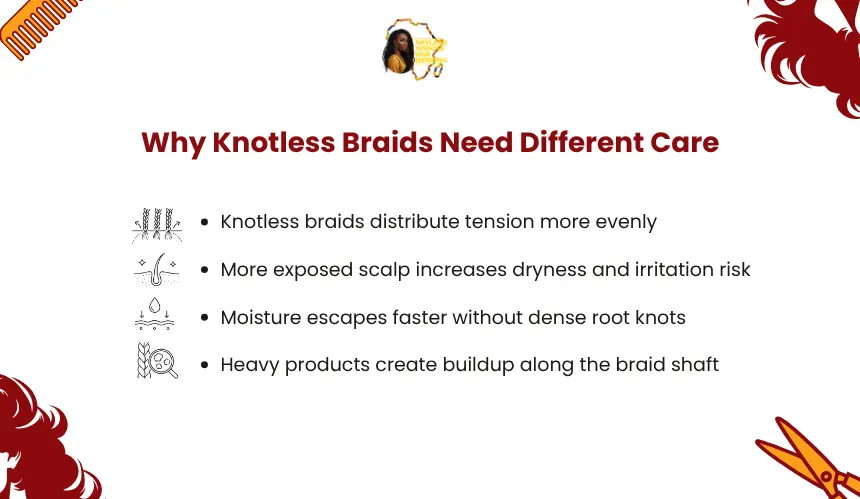
Knotless braids change how tension, moisture, and product interact with the scalp and hair shaft, which directly impacts how they should be maintained. Applying standard braided hair routines often leads to imbalance, either through excess buildup or insufficient hydration.
Natural Tension Distribution and Scalp Exposure Differences in Knotless Braids
Knotless braids use a feed-in technique that distributes weight gradually along the braid rather than concentrating it at the root. This reduces traction on follicles but leaves more of the scalp exposed between parts.
As a result, the scalp is more directly affected by environmental factors such as dryness, sweat, and product residue. Care routines must therefore prioritize scalp-level maintenance rather than focusing only on the braid length.
How the Structure of Knotless Braids Affects Moisture Retention and Buildup
Unlike knot-based styles, knotless braids do not have a dense anchor point to trap moisture at the root. Moisture applied to the scalp or hair dissipates more quickly, especially in open-part sections. At the same time, repeated product layering can accumulate along the braid shaft, where it is harder to remove without washing.
This creates a dual challenge where the scalp becomes dry while the braids hold buildup, requiring controlled hydration and minimal product layering.
Risks of Improper Care: Dryness, Breakage, and Scalp Irritation
When moisture is not maintained at the scalp level, dryness leads to flaking and irritation, which can trigger scratching and disrupt the braid structure. Overuse of heavy oils or creams contributes to residue accumulation, increasing the risk of clogged follicles and odor. Inconsistent cleansing further compounds these issues, creating an environment where both scalp health and braid longevity decline.
What Is the Ideal Daily and Weekly Routine for Knotless Braids?
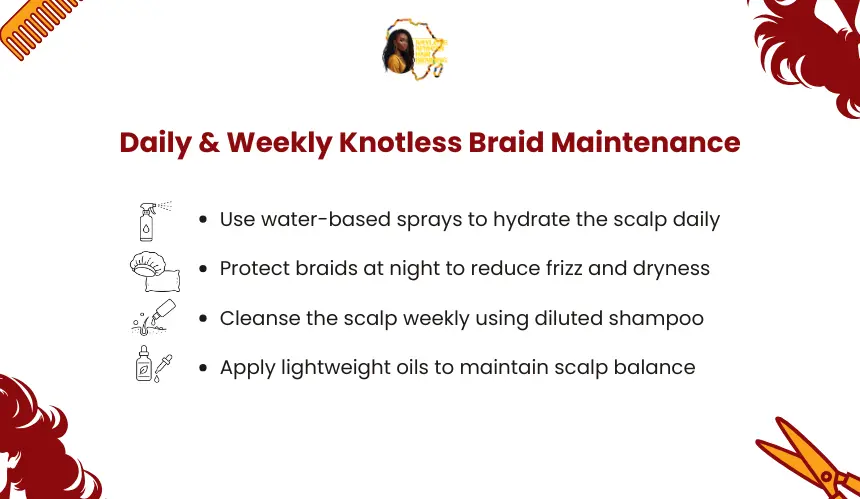
An effective routine for knotless braids is built on controlled hydration, targeted scalp care, and minimal manipulation. The goal is to maintain moisture balance without triggering buildup or loosening the braid structure.
Daily Care Essentials for Scalp and Braid Maintenance
Daily maintenance should focus on keeping the scalp hydrated and the braids protected from friction and environmental stress. Since the scalp is more exposed, neglecting daily care leads to rapid dryness and irritation.
- Apply a light, water-based leave-in or braid spray to the scalp to maintain hydration without residue accumulation
- Use a nozzle bottle or spray applicator to target the scalp directly instead of saturating the braid length
- Gently massage the scalp to improve circulation and distribute product evenly without disturbing the braids
- Protect braids at night using a satin bonnet or silk pillowcase to reduce friction, frizz, and moisture loss
Weekly Maintenance to Prevent Buildup and Damage
Weekly care is essential to reset the scalp environment and control product accumulation. Without structured weekly maintenance, residue builds up and compromises both hygiene and style longevity.
- Cleanse the scalp using diluted shampoo applied through an applicator bottle to avoid disrupting braid tension
- Focus on the scalp rather than aggressively washing the full braid length to reduce frizz and loosening
- Apply lightweight oils in controlled amounts after cleansing to restore scalp balance without clogging pores
- Smooth frizz along the braid length using light mousse or braid-specific products instead of heavy creams
Which Products and Ingredients Work Best for Knotless Braids?
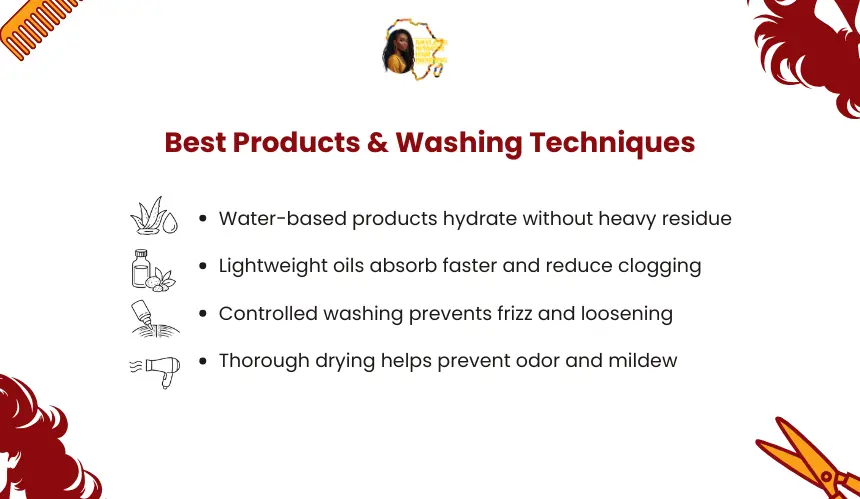
Product selection directly determines whether the routine maintains balance or creates buildup. Knotless braids require formulations that hydrate the scalp, absorb quickly, and leave minimal residue along the braid shaft.
Hydration-Focused Products That Prevent Dryness
Hydration should come from water-based formulations that penetrate the scalp instead of coating the hair surface. Products built around aloe vera, glycerin, or rose water deliver moisture without leaving a film that attracts debris.
Braid sprays and lightweight leave-in conditioners maintain elasticity at the root level, reducing flaking and minimizing tension-related stress on new growth.
Oils and Treatments That Support Scalp Health
Oils function as sealants rather than primary moisturizers, so their application must follow hydration. Lightweight options such as jojoba, grapeseed, or argan oil closely mimic natural sebum, allowing faster absorption and reducing pore blockage. Tea tree oil, when diluted, introduces antimicrobial properties that help control itch and microbial buildup on the scalp.
Ingredients to Avoid That Cause Buildup or Irritation
Heavy butters and dense oil blends accumulate along the braid shaft, especially when applied repeatedly without cleansing. Silicones create a coating that traps debris and limits moisture exchange, while high-alcohol formulations strip hydration and trigger scalp dryness.
Product selection should prioritize low-residue, breathable formulations that maintain scalp function rather than masking dryness with surface-level shine.
How Should You Wash and Refresh Knotless Braids Without Ruining Them?
Washing knotless braids requires controlled application techniques that clean the scalp without disturbing braid tension or causing frizz. The focus is on precision, not saturation, to maintain both hygiene and style integrity.
Step-by-Step Low-Manipulation Washing Method for Knotless Braids
Effective washing starts with reducing mechanical stress on the braids while ensuring the scalp is properly cleansed. Water and shampoo must be directed with control rather than applied broadly.
- Section the braids into manageable parts to maintain control during washing
- Use a diluted shampoo mixture in an applicator bottle to target the scalp directly
- Apply the solution along the parts and gently massage using fingertips, avoiding aggressive scrubbing
- Allow the diluted shampoo to run through the braid length during rinsing instead of manually rubbing the braids
Drying Techniques That Prevent Odor and Mildew
Improper drying creates a high-risk environment for odor and microbial growth due to trapped moisture within the braid structure. Drying must be thorough and controlled.
- Gently squeeze excess water using a microfiber towel instead of rubbing
- Allow braids to air dry in a well-ventilated space to promote even moisture evaporation
- Use a blow dryer on a low or cool setting if needed to ensure the inner braid layers dry completely
Refreshing Between Washes Without Overwashing
Frequent washing can loosen braids, so interim refresh methods help maintain scalp cleanliness without full cleansing cycles.
- Use scalp tonics or witch hazel-based solutions to break down light residue and control itch
- Apply dry shampoo alternatives selectively at the scalp to absorb excess oil
- Rehydrate lightly with water-based sprays to maintain moisture balance without restarting buildup cycles
How Can You Extend the Lifespan of Knotless Braids While Protecting Natural Hair?
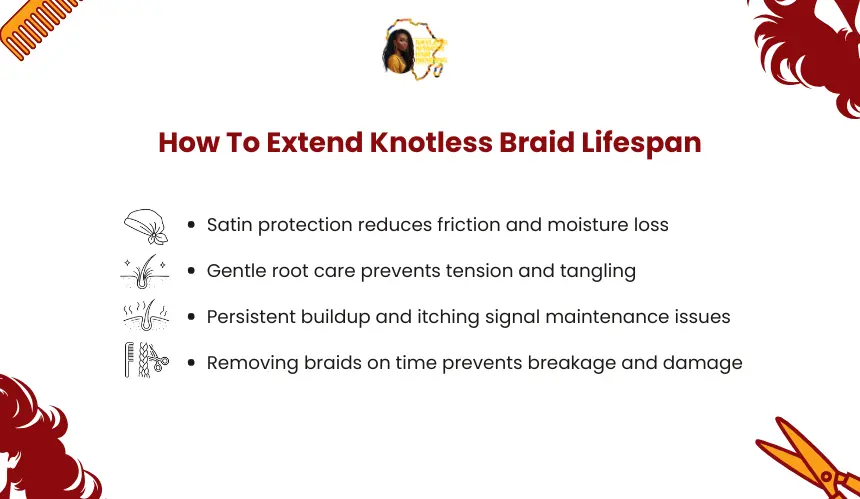
Extending the lifespan of knotless braids depends on reducing mechanical stress at the roots, controlling environmental exposure, and maintaining structural stability as new growth appears. Longevity is achieved by preserving both the braid integrity and the condition of the underlying hair.
Night Protection and Friction Reduction Strategies
Friction between braids and external surfaces accelerates frizz, weakens the braid pattern, and strips moisture from both the extensions and natural hair. Using satin or silk coverings creates a low-friction barrier that preserves braid alignment and reduces cuticle disruption.
Securing braids in a loose bundle or braid wrap further limits unnecessary movement during sleep, maintaining a cleaner structure for longer periods.
Managing New Growth Without Causing Tension
As natural hair grows, the base of the braid loosens, which can lead to tangling or uneven tension if handled incorrectly. Instead of re-tightening, which reintroduces stress to the follicles, maintenance should focus on keeping new growth hydrated and gently separated.
Light scalp conditioning and controlled styling prevent matting at the roots while preserving the low-tension advantage of knotless braids.
Signs It’s Time to Remove Braids to Prevent Damage
Keeping braids beyond their optimal duration shifts the risk from maintenance to damage control. Excessive buildup, persistent scalp irritation, and visible slippage at the roots indicate that the braid structure is no longer stable.
At this stage, continued wear increases the likelihood of breakage and knotting at the base, making safe removal more difficult and compromising overall hair health.
What Common Mistakes Ruin Knotless Braids and How Can You Avoid Them?
Most issues with knotless braids stem from imbalance, either too much product, too little moisture, or inconsistent scalp care. These errors, explained below, disrupt the intended low-tension structure and accelerate both style breakdown and hair damage.
- Over-moisturizing without proper absorption creates a damp scalp environment that promotes buildup and weakens the braid base. Hydration should be light, targeted, and followed by adequate drying time to maintain scalp stability.
- Excessive product layering leads to residue accumulation along the braid shaft, which is difficult to remove without frequent washing. This not only affects appearance but also blocks moisture from reaching the scalp effectively.
- Neglecting scalp health while focusing only on braid appearance results in itch, flaking, and microbial imbalance. Since knotless braids expose more scalp surface, maintenance must prioritize scalp condition rather than just keeping the braids neat.
- Extending wear beyond a safe timeframe increases tension at the roots due to new growth and trapped buildup. This shifts the style from protective to damaging, increasing the risk of breakage during both wear and removal.
How Do Local Climate and Environmental Factors Influence Knotless Braid Care?
In Washington State, particularly in areas like Lakewood, the climate introduces consistent moisture exposure due to frequent rainfall and elevated humidity levels throughout much of the year. This environment increases scalp perspiration and slows down moisture evaporation within the braid structure, which can lead to odor formation and product buildup if not managed correctly. In such conditions, cleansing frequency often needs to be slightly higher, using diluted shampoos and lightweight, water-based products that do not trap excess residue.
Lakewood’s proximity to Puget Sound also contributes to damp air conditions, meaning braids can retain internal moisture longer after washing. This makes thorough drying a critical step, as incomplete drying creates a breeding ground for mildew within dense braid sections. Using controlled airflow or extended air-drying in ventilated spaces becomes essential to maintain scalp hygiene and prevent long-term odor issues.
Nearby areas such as Parkland, University Place, and Puyallup share similar Pacific Northwest weather patterns, but localized variations like suburban dust exposure or seasonal pollen can further impact scalp cleanliness. During spring and early summer, increased airborne particles can settle on the scalp, requiring more consistent refresh routines using scalp tonics or gentle cleansing methods.
Maintaining knotless braids isn’t about guesswork; it’s about using the right techniques for lasting results. If you want a style that stays neat, healthy, and low-maintenance from day one, the team at AmyLove Africa Hair Braiding delivers precision braiding with expert care guidance built into every appointment.