
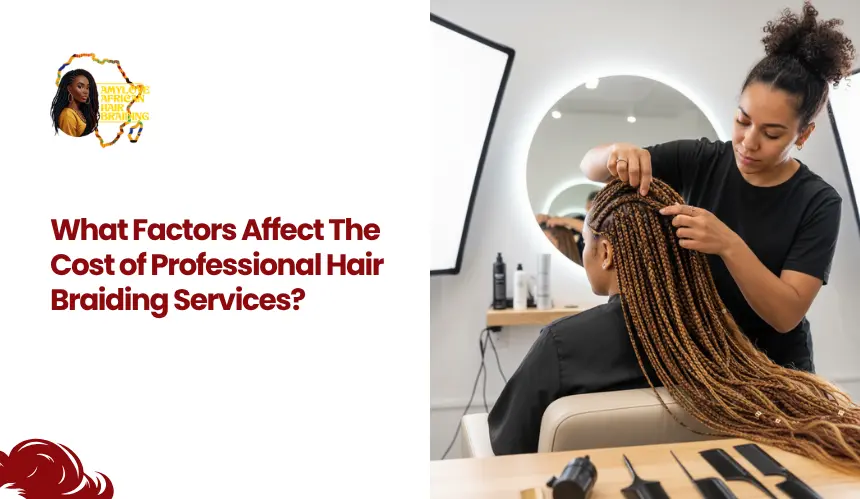
What Factors Affect The Cost of Professional Hair Braiding Services?
Key Takeaways
|
Professional hair braiding prices can feel confusing at first glance. Two people may request what appears to be a similar style, yet receive very different quotes. This often leads to uncertainty about what actually drives the cost and whether the pricing reflects value or variability.
The cost of professional hair braiding services is shaped by multiple service-specific and client-specific factors rather than a single fixed rate. Understanding these factors helps clients set realistic expectations and compare services accurately.
This article breaks down the key elements that influence hair braiding costs, focusing on how services are structured, priced, and delivered in professional settings.
1. Type of Braiding Style and Design Complexity
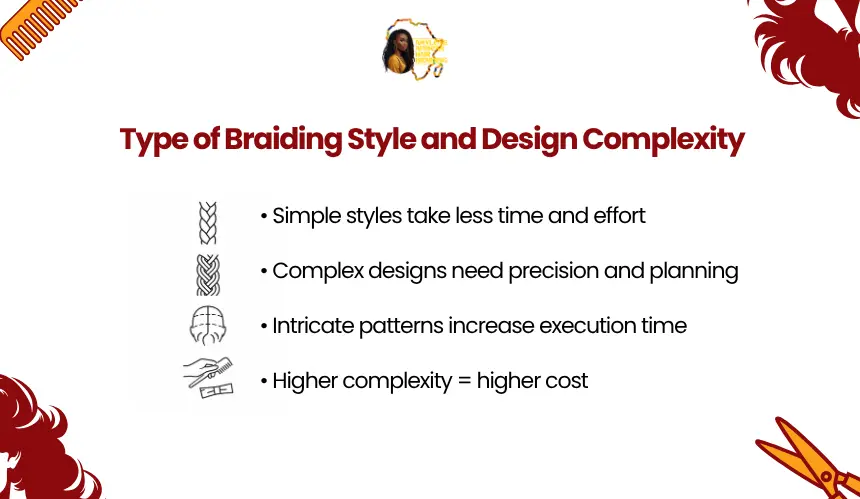
Braiding costs begin to shift as soon as the style itself changes. Even when the same stylist performs the service, different braid designs demand different levels of planning, precision, and execution. The structure of the style determines how much technical effort is required before the first braid is even completed.
How Braiding Style Complexity Influences Overall Pricing
Straightforward styles such as basic cornrows or two-strand twists follow predictable patterns and require minimal design variation.
These styles allow the braider to work efficiently with consistent sectioning and repetition, which keeps labor time controlled and pricing more accessible.
In contrast, intricate braiding styles increase cost because they introduce design complexity. Feed-in braids, knotless techniques, geometric parting, and custom patterns require advanced section mapping, continuous adjustment, and higher concentration throughout the service.
Each design choice affects symmetry, tension control, and visual balance, all of which demand more technical skill and slower execution. As complexity increases, pricing reflects the added precision rather than just the finished look.
2. Hair Length, Thickness, and Natural Texture
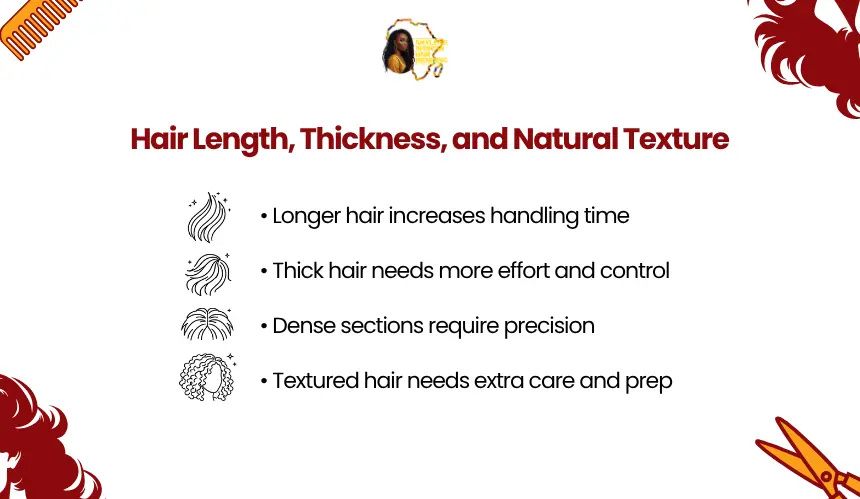
Beyond the braid style itself, individual hair characteristics play a major role in how a service is priced. Professional braiding is a hands-on process, and the physical properties of the client’s hair directly influence preparation time, handling effort, and overall workload during the appointment.
How Hair Length, Density, and Texture Affect Braiding Costs
Longer hair typically increases braiding time because sectioning, detangling, and managing extended strands requires additional control at every stage of the process.
Thick or high-density hair further adds to this effort, as each section contains more volume and demands stronger grip and precision to maintain clean parting and even tension.
Natural texture also affects pricing when it requires specialized handling. Coarse, tightly coiled, or highly textured hair often needs extra detangling, moisture control, and careful manipulation to prevent breakage and discomfort.
These factors extend service time and physical effort, which is why braiding costs are often adjusted based on hair length, thickness, and natural texture rather than treated as a flat-rate service.
3. Size, Length, and Number of Braids
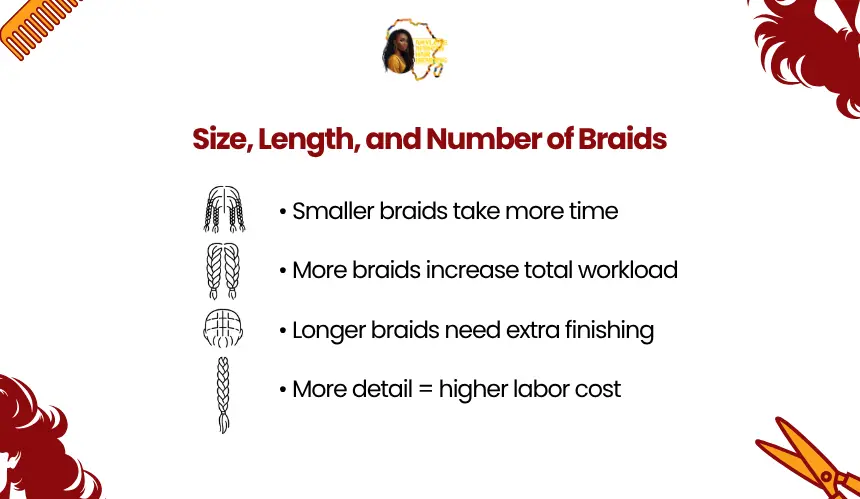
After hair characteristics are considered, pricing is further shaped by how the braids are structured across the head. Braid size and total count directly affect how long a stylist works on the service, making this one of the most measurable cost factors in professional braiding.
How Braid Size and Quantity Determine Service Time and Price
Smaller braids increase cost because they require more sections, tighter control, and repeated precision across the entire scalp.
Micro, small box braids, and knotless styles involve dozens or even hundreds of individual braids, each needing consistent tension, clean parting, and uniform placement. The cumulative time required to complete these details significantly raises labor demands.
Larger or jumbo braids reduce the total number of sections, allowing the service to move faster and with less repetitive strain. Braid length further influences pricing, as longer braids require extended handling, added finishing time, and greater attention to balance and weight distribution.
When braid size, length, and quantity increase together, pricing reflects the total labor commitment rather than a single visual factor.
4. Use of Hair Extensions and Added Materials
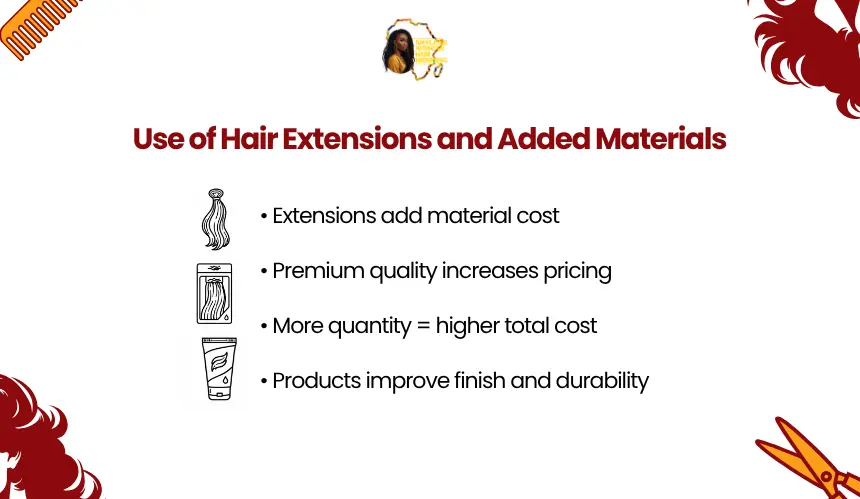
Materials introduce another pricing layer that goes beyond labor alone. Many professional braiding services rely on extensions or added products, and these materials influence both the final look and the total service cost.
How Extension Type and Material Quality Influence Braiding Prices
Braiding services that include hair extensions typically factor in the type, quantity, and quality of the added hair. Synthetic extensions are more commonly used and vary widely in price depending on texture, weight, and finish.
Pre-stretched hair, color-blended packs, and lightweight fibers often cost more because they reduce installation time and improve visual consistency.
Human hair extensions increase pricing further due to higher material costs and added handling care during installation. In addition to extensions, other materials such as styling gels, scalp protectants, and finishing products may be included in the service.
When extensions and materials are supplied by the stylist, pricing reflects both the product expense and the responsibility for achieving durability, comfort, and a polished result.
5. Stylist Experience, Training, and Professional Skill Level
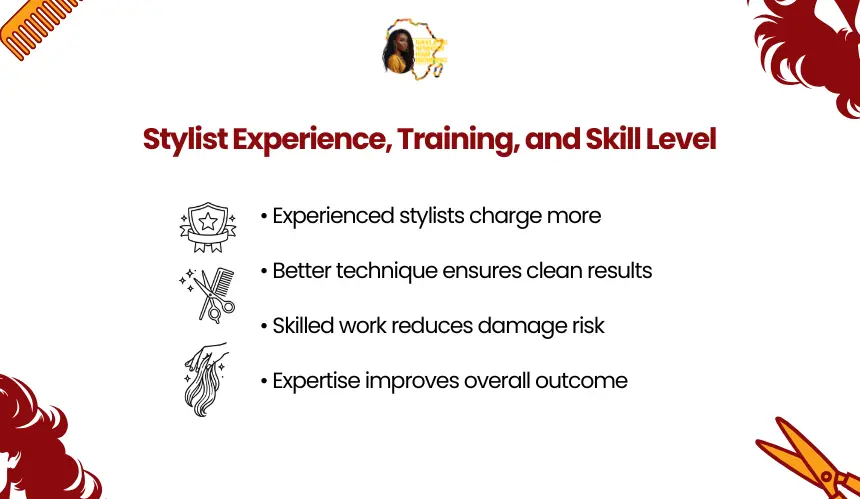
Pricing differences often reflect who is performing the service rather than the service alone. Professional hair braiding relies heavily on technical ability, and a stylist’s background directly influences both efficiency and outcome quality.
How Professional Experience Shapes Braiding Service Pricing
Experienced braiders typically charge more because they bring refined technique, speed consistency, and a deeper understanding of scalp health and tension control. Training allows them to execute complex styles cleanly while minimizing discomfort and reducing the risk of premature unraveling or breakage.
Less experienced braiders may offer lower prices, but services often take longer and require more adjustments during installation. Professional expertise reduces trial-and-error during sectioning, extension placement, and finishing, which is why pricing often reflects years of hands-on experience rather than the visible style alone.
6. Appointment Duration and Time Commitment
Time is one of the most valuable resources in professional braiding services. Unlike quick salon treatments, braiding often requires extended, uninterrupted sessions that limit how many clients a stylist can serve in a day.
Why Longer Braiding Appointments Increase Overall Cost
Short appointments for basic styles typically fit within predictable time blocks, allowing stylists to schedule multiple clients. In contrast, detailed braiding services can take several hours or span most of the day.
During these longer sessions, the stylist commits physical focus, repetitive hand motion, and sustained precision without overlapping other appointments.
Pricing accounts for this time commitment because longer services reduce daily availability and increase physical strain. When a stylist dedicates an entire day to a single client, the cost reflects the opportunity cost of unavailable booking slots rather than just the styling process itself.
7. Location, Salon Environment, and Operating Overhead
Where a braiding service is performed plays a role in how pricing is structured. Professional settings carry operational responsibilities that extend beyond the styling chair.
How Salon Environment and Business Costs Affect Pricing
Braiding services offered in licensed salons typically include higher pricing due to rent, utilities, sanitation standards, insurance, and professional equipment. These environments also provide client comfort, regulated hygiene practices, and consistent service conditions, all of which contribute to operating expenses.
Independent or home-based braiders may charge differently because their overhead is lower. However, pricing differences often reflect business structure rather than skill level alone.
Professional settings factor operational stability into service pricing, ensuring compliance, reliability, and a standardized client experience.
8. Additional Services and Custom Requests
Braiding prices often increase when the service extends beyond installation alone. Custom requests and add-ons change the scope of work and require additional preparation or finishing time.
Which Add-On Services Commonly Increase Braiding Costs
Services such as hair washing, blow-drying, scalp treatments, and trimming add time before braiding begins. These steps prepare the hair for longevity and comfort but are not always included in base pricing. Decorative elements like accessories, layered styling, or personalized finishing techniques also extend service duration.
Custom requests require planning adjustments and material use, which is why pricing reflects service expansion rather than aesthetic preference.
When add-ons are included, clients are paying for extended care and personalization rather than the braid installation alone.
Common Pricing Structures Used by Professional Braiders
Understanding how pricing is calculated helps clients interpret quotes accurately. Braiding services do not follow a single pricing model, and structure varies by stylist and service type.
Some braiders use flat rates based on style type, braid size, and length. This approach provides predictability and simplifies booking. Others rely on hourly pricing, especially for custom or variable services where hair condition and design complexity affect time commitment.
Consultation-based pricing is also common for detailed styles. In these cases, the final cost is determined after assessing hair length, density, materials, and requested design. Each pricing structure reflects an attempt to balance transparency with service variability.
Frequently Asked Questions
Why do smaller braids usually cost more than larger ones?
Smaller braids require significantly more sections, repetition, and precision across the scalp. Each braid must be evenly sized, properly tensioned, and securely finished, which increases total installation time and physical effort. The higher cost reflects the cumulative labor involved rather than the visual size of the braids.
Does thicker hair always increase braiding prices?
Thicker or high-density hair often takes longer to detangle, section, and control during braiding, which can raise service time. However, pricing adjustments depend on how the hair responds during preparation and styling rather than thickness alone. Some textures are dense yet manageable, while others require additional handling.
Are hair extensions usually included in the service price?
Inclusion of extensions varies by stylist and service structure. Some braiders bundle standard synthetic hair into the base price, while others charge separately based on brand, length, or color customization. Clarifying this in advance helps avoid pricing surprises and ensures material quality meets expectations.
How far in advance should pricing be discussed?
Pricing should be confirmed at least 24 to 72 hours before the appointment, ideally at the time of booking or during a brief consultation. This allows the stylist to accurately account for hair length, braid size, extension quantity, and any add-on services.
Discussing pricing in advance prevents last-minute adjustments, scheduling delays, or unexpected cost changes on the appointment day.
Is tipping expected for professional hair braiding services?
Tipping is not always mandatory, but many clients choose to tip based on service quality, comfort, and time commitment. Longer appointments or highly detailed work often influence tipping decisions, making it a personal expression of satisfaction rather than a fixed requirement.