Are Knotless Braids Better For Sensitive Scalps?
Key Takeaways
|
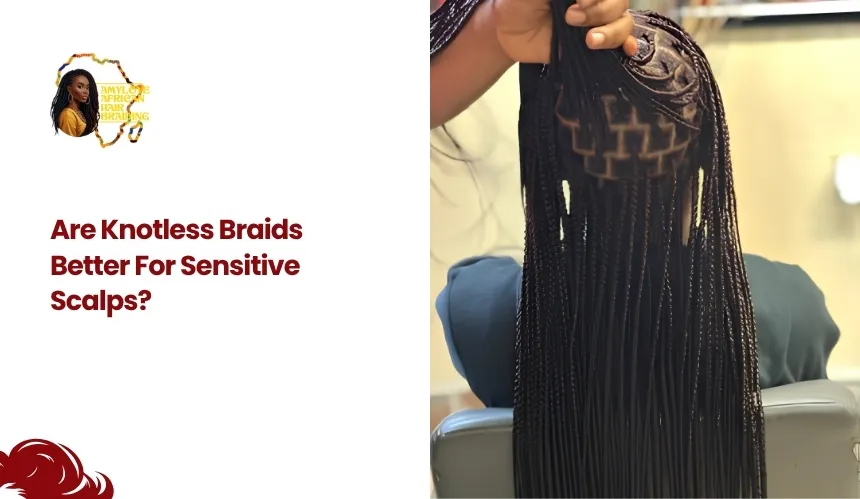
Knotless braids are often chosen by people who want a protective style that feels lighter, softer, and more comfortable on the scalp. For anyone with scalp sensitivity, the way braids are installed can make a big difference in how the style feels over time.
While knotless braids are known for being gentler than many traditional braid styles, comfort still depends on the braider’s technique, hair condition, and how the scalp responds after installation.
Do You Know? According to American Dermatology, dermatologists warn that hairstyles that repeatedly pull on the hair can lead to traction alopecia, a form of hair loss linked to ongoing tension at the follicles. This makes braid tension more important than the braid name itself. |
Why Knotless Braids May Feel Better on Sensitive Scalps
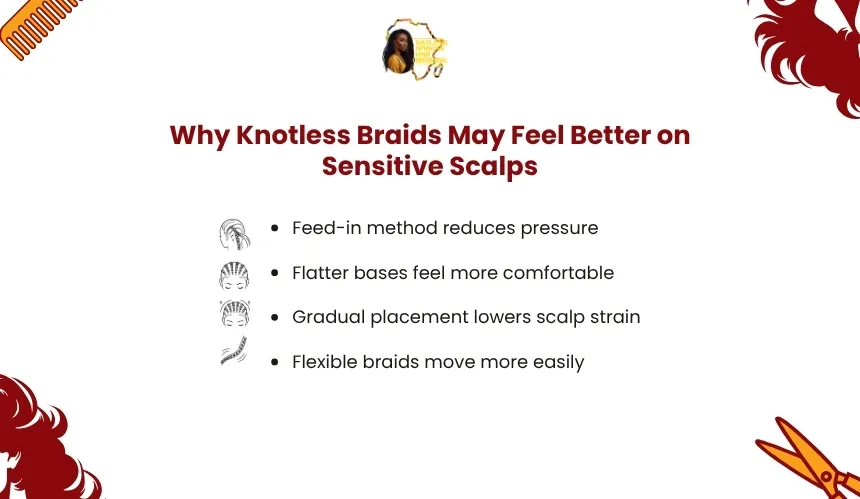
Knotless braids are often easier on sensitive scalps because they are built with less pressure at the starting point of each braid. Instead of locking extension hair tightly at the root, the style allows the braid to develop more gradually.
Lakewood’s cool, damp, and often rainy climate can make natural hair harder to manage, especially during wetter months. For people in areas like Oakbrook, Downtown Lakewood, and Springbrook, knotless braids gained popularity in Lakewood, offering a protective style that feels lighter, stays manageable, and reduces daily styling stress.
The style also fits active routines around South Tacoma Way. Because knotless braids are flexible, low-maintenance, and gentler at the roots when installed properly, they remain a practical choice for comfort, scalp protection, and everyday wear in Lakewood.
How Does the Feed-In Method Reduce Root Pressure?
Knotless braids begin with the client’s natural hair before small amounts of extension hair are added into the braid. This creates a softer starting point and reduces the sudden pressure that can happen when a braid begins with a tight knot.
For sensitive scalps, this matters because the hair follicles are not forced to hold the full weight of the braid from the first stitch. The result is usually a lighter, more flexible feeling during the first few days after installation, when scalp tenderness is most common.
Did You Know? The American Academy of Dermatology recommends loosening braids around the hairline because this area is especially vulnerable to constant pulling. This supports why knotless braids may feel better when they are installed with a softer, lower-tension base. |
Why Does a Flatter Braid Base Feel More Comfortable?
Traditional box braids often start with a visible knot that sits close to the scalp. That knot can create a firm pressure point, especially when the braids are fresh, pulled into a style, or pressed against a pillow during sleep.
Knotless braids sit flatter because there is no bulky knot at the base. This reduces direct rubbing against the scalp and makes the braid foundation feel smoother. For people who experience tenderness, itching, or small bumps after tight styles, the flatter base can make a noticeable difference.
Did You Know? Indian Journal of Dermatology, Venereology and Leprology notes that traction alopecia can begin as a reversible condition, but delayed action can allow it to progress into scarring hair loss. This is why early discomfort from tight braids should be treated as a warning sign, not a normal part of protective styling. |
How Does Gradual Extension Placement Lower Scalp Strain?
The gradual addition of braiding hair helps spread the braid’s weight more evenly along the strand. Instead of concentrating tension in one small root area, the structure distributes pressure more naturally through the braid.
This is useful for sensitive scalps because uneven pulling can make certain areas feel sore faster than others. A more balanced braid places less strain on the scalp during normal movement, washing, or light styling.
Why Do Knotless Braids Move More Easily?
Knotless braids usually have more natural movement because they are not anchored by a stiff root knot. The braid can shift with the head instead of pulling sharply every time the hair moves.
This flexibility can reduce discomfort when wearing the hair down, sleeping, or creating loose styles. For sensitive scalps, easier movement means fewer sharp tugging sensations around the hairline, crown, and nape.
When Knotless Braids Can Still Irritate the Scalp
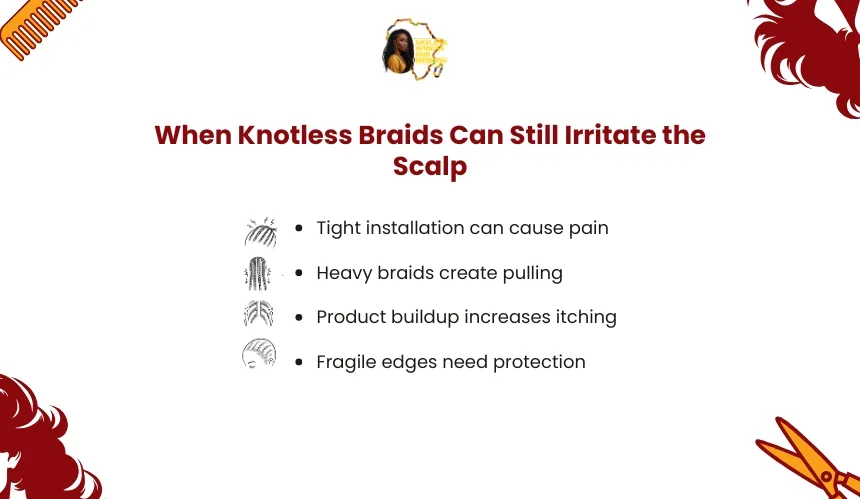
Knotless braids are not automatically pain-free. Even a gentler braid style can cause irritation if the scalp is exposed to too much grip, too much extension weight, harsh products, or existing scalp weakness.
How Can Tight Installation Still Cause Pain?
Knotless braids can still hurt if the braider pulls the natural hair too firmly while forming each section. The absence of a knot does not protect the scalp if the braid itself is created with excessive force.
Signs of tight installation include soreness, redness, raised skin, a sharp pulling sensation, or small bumps around the parts. These symptoms often appear around the temples, edges, crown, and nape because those areas tend to be more delicate.
If the scalp feels painfully stretched, the style is too tight. A protective style should not require several days of discomfort before it becomes wearable.
Did You Know? Harvard T.H. Chan School of Public Health reported on Consumer Reports testing that found toxins in all 10 synthetic braiding hair products tested, including benzene in three products and unsafe lead levels in nine of 10 products. This does not mean every scalp reaction is chemical-related, but it supports taking synthetic hair sensitivity seriously. |
Why Can Heavy or Extra-Long Braids Become a Problem?
Heavy knotless braids can irritate sensitive scalps because the added hair creates constant downward pull. This may happen with extra-long lengths, oversized braids, or dense extension use.
The issue is not always felt immediately. A style may feel fine at first, then become uncomfortable when the braids swing, get tied up, absorb water, or press against the scalp during sleep.
People with fine hair, low-density hair, or fragile roots may feel this strain faster. In those cases, a lighter braid design is usually safer than a dramatic long or heavy style.
How Can Scalp Dryness, Buildup, or Product Sensitivity Cause Irritation?
A sensitive scalp can react badly when braids are installed over dryness, flakes, sweat, or old product residue. Once the hair is parted and braided, the scalp has less freedom to recover from existing irritation.
Heavy gels, thick oils, edge control, and scented sprays can also collect around the roots. This buildup may clog follicles, trap sweat, and make itching or tenderness worse.
Some people are also sensitive to synthetic braiding hair or fragrance-heavy products. If the scalp burns, itches intensely, or becomes inflamed soon after installation, the reaction may be product-related rather than tension-related.
Did You Know? A 2025 review in Dermatitis notes that synthetic hair extensions can contribute to contact dermatitis because of allergens such as acrylates and disperse dyes. The review also found fragrance to be a common allergen in hair styling products |
Why Are Fragile Edges or Existing Scalp Issues Riskier?
Weak edges, thinning areas, or an already irritated scalp need extra protection before any braid style is installed. These areas cannot handle the same pressure as stronger sections of hair.
Braiding over sores, severe dandruff, active itching, redness, or scalp tenderness can make the condition worse. In these cases, knotless braids may still create stress, even when the installation looks neat.
A safer approach is to let the scalp calm down first or ask the braider to reduce tension, use less extension hair, and avoid pulling delicate hairline sections into tight braids.
How to Make Knotless Braids Safer for Sensitive Scalps
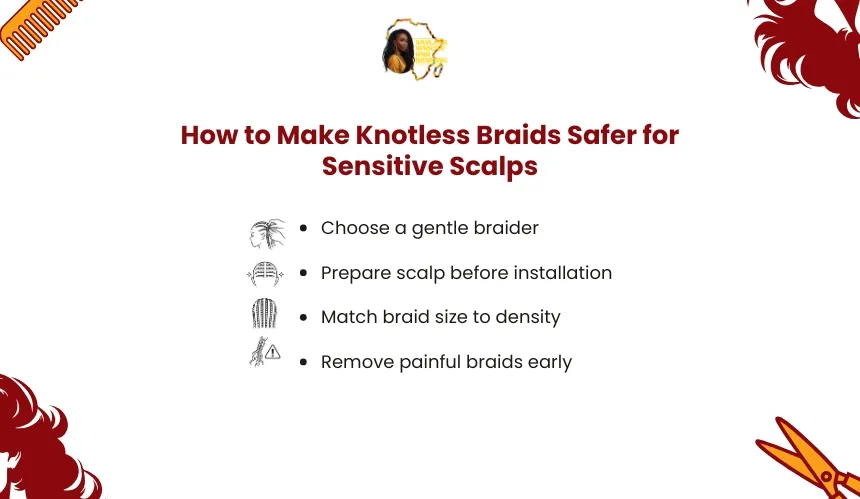
Knotless braids are safest when the style is planned around scalp comfort from the beginning. The goal is to reduce avoidable tension, prevent buildup, and respond early if the scalp shows signs of stress.
How Should You Choose a Braider for a Sensitive Scalp?
Choose a braider who understands that neat braids do not need to be painful. A skilled braider should be able to create a secure braid without pulling the scalp tightly or making the roots feel stiff.
The braider should adjust grip, part size, and extension amount based on hair density and scalp sensitivity. Areas like the edges, temples, and nape should be handled with less force because they are more prone to breakage and irritation.
During the appointment, pain should be addressed immediately. If a section feels too tight while it is being braided, it will likely feel worse once the full style is complete.
How Should the Scalp Be Prepared Before Installation?
The scalp should be clean, calm, and lightly moisturized before knotless braids are installed. A gentle wash removes sweat, flakes, oil, and old styling products that could lead to itching under the braids.
The scalp should not be scrubbed aggressively right before the appointment because rough cleansing can create tenderness before braiding begins. Light hydration is better than heavy product layering because thick products can collect around the parts after installation.
If the scalp is already burning, flaking heavily, sore, or inflamed, it is better to delay the style. Braids should protect healthy hair, not cover an active scalp problem.
What Braid Size and Length Are Best for Sensitive Scalps?
Medium or small-medium knotless braids are often a practical choice for sensitive scalps because they balance comfort, durability, and weight control. Very tiny braids can place pressure on small hair sections, while very large braids may require too much extension hair per part.
Length should also be chosen carefully. Shoulder-length, mid-back, or moderate-length braids usually create less pull than waist-length or hip-length styles.
The braid size should match the person’s natural hair density. Fine or low-density hair should not be forced to carry thick, heavy extensions because that can stress the follicles over time.
Crochet braids have gained popularity in Lakewood because they give clients more styling flexibility without requiring every strand to be individually braided with extensions. In a city with wet, overcast winters and short, drier summers, many people want styles that can handle moisture, reduce daily heat styling, and still look polished between washes.
For clients around American Lake, Custer, Clover Park, Lake Louise, Lake Steilacoom, Interlaken, and Wards Lake, crochet braids in Lakewood offer a practical option for curls, twists, loc-inspired looks, and textured protective styles that can be changed more easily than traditional long-term braid installs.
What makes crochet braids different is the installation method. The natural hair is usually cornrowed first, then crochet hair is looped into the base, which can reduce repeated handling of the natural hair during styling.
This makes the service useful for Lakewood clients with busy routines near schools, residential areas, lake communities, and commuter corridors who want a protective look with faster installation, easier style variety, and less daily manipulation.
When Should Knotless Braids Be Loosened or Removed?
Knotless braids should be loosened or removed if the scalp develops ongoing pain, swelling, bumps, burning, redness, or intense itching. Mild tightness may settle, but sharp or worsening discomfort is a warning sign.
Small bumps near the roots often point to tension stress. Itching with flakes, odor, or tenderness may point to buildup, dryness, or product sensitivity.
If the scalp feels painful when sleeping, moving the braids, or lightly styling the hair, the style may be too tight or too heavy. Removing the braids early is safer than keeping a damaging style for the sake of appearance.
Did You Know? Mayo Clinic lists folliculitis symptoms as small bumps or pimples around hair follicles, itchy or burning skin, and painful or tender skin. If similar symptoms appear after braiding, the scalp may be reacting to tension, irritation, buildup, or inflamed follicles. |
Ready for a braid style that feels comfortable, protective, and beautifully finished? AmyLove Hair Braiding offers professional braid services designed around your hair type, scalp comfort, and preferred look. Whether you want knotless braids, crochet braids, box braids, or another protective style, the team focuses on clean parts, balanced tension, and long-lasting results.
Frequently Asked Quetions
How long should someone with a sensitive scalp keep knotless braids?
People with sensitive scalps should avoid keeping knotless braids in for too long, even if the style still looks neat. A shorter wear period helps reduce buildup, root stress, dryness, and follicle irritation. If itching, tenderness, or bumps appear early, removal should happen sooner than planned.
Can knotless braids help if traditional box braids always feel painful?
Knotless braids may be a better choice for people who often feel pain from traditional box braids because they remove the firm knot at the base. However, comfort still depends on braid size, hair density, parting technique, extension weight, and how gently the braider handles the roots.
Is it normal for knotless braids to itch after installation?
Some mild itching can happen from scalp dryness, new product use, synthetic hair, or exposed parts, but strong itching is not something to ignore. Burning, bumps, flakes, odor, or tenderness may point to buildup, contact sensitivity, follicle irritation, or excessive tension around the roots.
Are crochet braids a good alternative for sensitive scalps?
Crochet braids can be a helpful alternative when someone wants a protective style with less individual braid manipulation. Since the natural hair is usually cornrowed first and crochet hair is looped through, the style may offer faster installation, more texture options, and reduced handling when installed gently.
What should clients tell their braider before getting knotless braids?
Clients should mention scalp sensitivity, tender areas, weak edges, past braid discomfort, product allergies, and preferred braid weight before installation begins. This helps the braider adjust tension, section size, feed-in amount, and hairline handling instead of using one standard technique for the whole scalp.
Can knotless braids be washed without causing more scalp irritation?
Knotless braids can be washed carefully, but the scalp should not be scratched aggressively or overloaded with thick products afterward. A gentle cleanse around the parts can remove sweat and buildup, while lightweight moisture helps prevent dryness without clogging follicles or making the roots feel heavy.